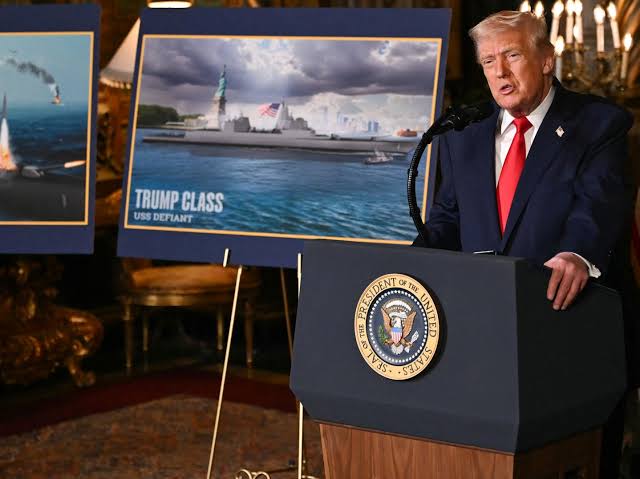
President Donald Trump has announced plans for a new class of U.S. Navy battleships, reviving a warship type last built nearly 80 years ago in a move that marks a dramatic break from modern naval doctrine, even as the Navy struggles with delays and cancellations across its current shipbuilding programmes.
Speaking at his Mar-a-Lago resort alongside Secretary of State Marco Rubio, Defence Secretary Pete Hegseth and Navy Secretary John Phelan, Trump revealed the proposed “Trump-class battleship”, claiming it would be “100 times more powerful” than any battleship previously constructed.
The lead vessel is to be named USS Defiant (BBG-1), with the ships expected to displace between 30,000 and more than 40,000 tonnes.
According to Trump, construction would begin immediately on two ships, followed by eight more, with the eventual aim of building between 20 and 25 battleships.
The vessels are intended to form the centrepiece of what he described as a future “Golden Fleet” for the U.S. Navy, alongside plans for a new class of aircraft carriers.
Secretary Phelan said the Trump-class would be the “largest, deadliest, most versatile and best-looking warship” afloat, drawing comparisons with the iconic Iowa-class battleships.
He added that the ships would carry nuclear-armed sea-launched cruise missiles, as well as advanced conventional weapons. By comparison, the USS Iowa displaced about 58,000 tonnes at full load and was armed with nine 16-inch guns, the largest ever deployed by the United States.
The Navy said the new class would be roughly three times the size of an Arleigh Burke-class destroyer, with vastly greater firepower and missile capacity.
The ships are expected to deploy hypersonic Conventional Prompt Strike weapons and nuclear-armed surface-launched cruise missiles, and could operate either alongside carrier strike groups or independently as flagships for surface action groups.
They would also serve as command-and-control hubs, coordinating air, surface and anti-submarine operations while delivering long-range strikes.
U.S. Chief of Naval Operations, Admiral Daryl Caudle, said the Navy required a larger surface combatant to meet future threats and argued that the Trump-class would help deter and defeat adversaries well into the 2030s and beyond.
The announcement comes against a backdrop of mounting pressure on U.S. naval shipbuilding. Recent years have seen repeated programme disruptions, including the cancellation of four Constellation-class frigates after delays pushed delivery of the lead ship back by three years.
In their place, the Navy has opted for a new frigate design based on the Legend-class National Security Cutter, using an accelerated acquisition approach to get ships into service more quickly.
Other programmes have also been scaled back or halted, including elements of the Coast Guard’s cutter plans and the troubled Offshore Patrol Cutter project.
At the same time, the Navy has pledged to continue building Arleigh Burke-class destroyers as the backbone of the surface fleet, while pursuing a “high-low mix” that balances advanced warships with simpler, faster-to-build platforms.
If realised, the Trump-class would mark the first U.S. battleship construction since work on USS Kentucky was suspended in 1947.
Battleships, once regarded as the “queens of the sea”, were eclipsed by air power during the Second World War and later relegated mainly to shore bombardment roles.
Their proposed return comes as U.S. naval leaders warn that America’s shipbuilding capacity lags far behind China’s rapidly expanding maritime industrial base, adding urgency and controversy to one of the most striking naval announcements in decades.