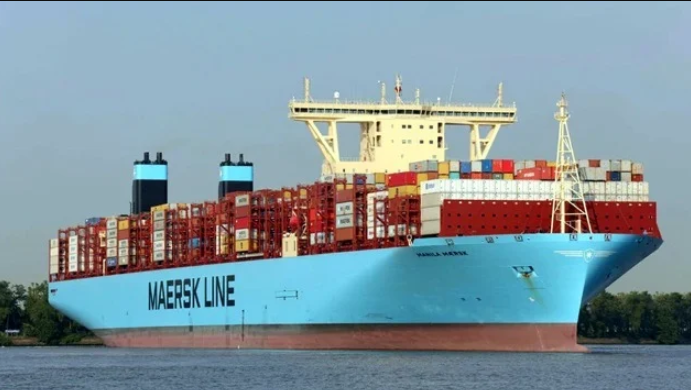
A.P. Moller – Maersk posted a resilient performance in 2025, navigating volatile market conditions to deliver results at the upper end of its financial guidance, driven by solid volume growth, disciplined operations and proactive cost control.
The shipping and logistics giant recorded full-year revenue of USD 54.0 billion, with EBITDA reaching USD 9.5 billion and EBIT standing at USD 3.5 billion. These results came against a backdrop of continued pressure on freight rates and persistent industry overcapacity, underscoring the company’s focus on execution and efficiency.
Maersk’s Ocean business grew volumes by 4.9% over the year, broadly in line with global market growth. High asset utilisation and the rollout of a new East–West network helped deliver average schedule reliability of more than 90%. Despite these operational gains, profitability in the segment declined as lower freight rates weighed on earnings.
The Logistics & Services division continued its gradual improvement in profitability following a period of targeted refocusing. While progress was evident, Maersk acknowledged that the segment has yet to reach its full potential and remains a key priority as the group sharpens its end-to-end logistics ambitions.
Terminals emerged as a standout performer, delivering the strongest financial results in their history. Record volumes, improved pricing and higher storage revenue lifted terminal revenues by 20% year on year, supported by sustained demand and ongoing investment in new locations as well as the modernisation of existing facilities.
In the final quarter of 2025, Ocean volumes rose sharply by 8.0%, but EBIT slipped to a loss of USD 153 million, compared with a profit of USD 567 million in the previous quarter and USD 1.6 billion in the same period a year earlier. Logistics & Services generated EBIT of USD 194 million, slightly down on the preceding quarter, while Terminals recorded EBIT of USD 321 million, reflecting a quarter-on-quarter decline linked to one-off items.
Shareholders are set to benefit from a proposed dividend of DKK480 per share, amounting to roughly USD1.1 billion and representing a payout ratio of 40%. The Board has also approved a share buy-back programme of up to DKK 6.3 billion, or about USD 1.0 billion, to be carried out over 12 months starting on 9 February 2026.
As part of a renewed push on cost discipline, Maersk announced plans to cut corporate overheads by USD 180 million annually. This will involve the closure of around 1,000 positions, equating to approximately 15% of corporate roles from a total workforce of about 6,000 in that category. The company also plans to regroup its Logistics & Services offerings into three clearer segments — Landside, Forwarding and Solutions — bringing its structure closer to prevailing industry standards.
Looking ahead, Maersk expects global container demand to grow by between 2% and 4% in 2026. For the year, the company has guided for underlying EBITDA of USD 4.5 billion to USD 7.0 billion, underlying EBIT ranging from a loss of USD 1.5 billion to a profit of USD 1.0 billion, and free cash flow of at least USD -3.0 billion. Capital expenditure guidance remains unchanged at USD 10.0–11.0 billion across both the 2025–2026 and 2026–2027 periods.
The outlook assumes continued industry overcapacity and factors in the extension of the estimated useful life of Maersk’s vessels from 20 to 25 years, effective from 1 January 2026, a move expected to reduce depreciation by around USD 700 million in 2026.