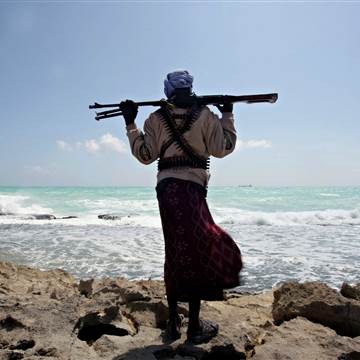
Fears of a renewed piracy crisis off the Somali coast have intensified after a second vessel was hijacked within days, raising fresh concerns for commercial shipping in one of the world’s most volatile maritime corridors.
The United Kingdom Maritime Trade Operations (UKMTO) reported that a cargo ship was seized approximately six nautical miles north-east of Garacad by unauthorised persons, who redirected the vessel into Somali territorial waters. The incident marks the latest in a string of attacks signalling a troubling resurgence of organised pirate activity in the region.
Earlier, on 21 April, the Palau-flagged tanker Honour 25 was captured by six armed men around 30 nautical miles off the Somali coast, according to security officials.
The tanker, carrying 17 crew members and a cargo of 18,500 barrels of oil, had departed from Puntland, Somalia’s semi-autonomous region.
UKMTO confirmed that the vessel was subsequently manoeuvred deeper into Somali waters, approximately 77 nautical miles south of its original position.
Following the second hijacking on 26 April, UKMTO issued a stark warning to vessels operating in the area, urging heightened caution and immediate reporting of any suspicious activity as authorities continue their investigations.
The Joint Maritime Information Center (JMIC) has since elevated its threat assessment for the Somali coast and Somali Basin to “substantial”, indicating a strong likelihood of further attacks.
In its latest advisory, JMIC confirmed that an oil-products tanker remains in pirate custody along the north-eastern Somali coastline, although no injuries have been reported.
It also warned of an active Pirate Action Group operating in the Somali Basin, advising vessels to maintain vigilance and adhere strictly to Best Management Practices for Maritime Security.
Additional incidents have underscored the escalating risk. A Somali-flagged fishing vessel was hijacked near Xaafuun on 23 April, while an attempted armed boarding was reported 83 nautical miles off Eyl, reinforcing concerns about coordinated pirate operations in the region.
Somali piracy once paralysed global shipping between 2008 and 2011, peaking in 2011 with more than 200 recorded attacks.
Pirates typically seized vessels and held crews hostage for ransom, costing the global economy billions and prompting an unprecedented international naval response.
Any resurgence now comes at a particularly precarious moment for global shipping. The wider region is already under strain, with the Strait of Hormuz effectively closed amid escalating conflict involving the United States, Israel and Iran.
Nearly 1,000 vessels and some 20,000 crew members are reportedly stranded in the Arabian Gulf, while a United States naval blockade in the Arabian Sea has further disrupted maritime traffic. JMIC currently rates the threat level in that theatre as critical.
Meanwhile, concerns persist over a potential escalation by Houthi forces in the Red Sea and the Bab el-Mandeb, although no recent attacks on commercial shipping have been confirmed. The threat level there remains moderate, but the convergence of risks across key waterways is adding to mounting anxiety within the global maritime industry.