Nigeria’s anti-narcotics and customs authorities have closed ranks in a renewed push against drug trafficking and transnational crime, unveiling a joint operational framework aimed at tightening border security without stifling legitimate trade.
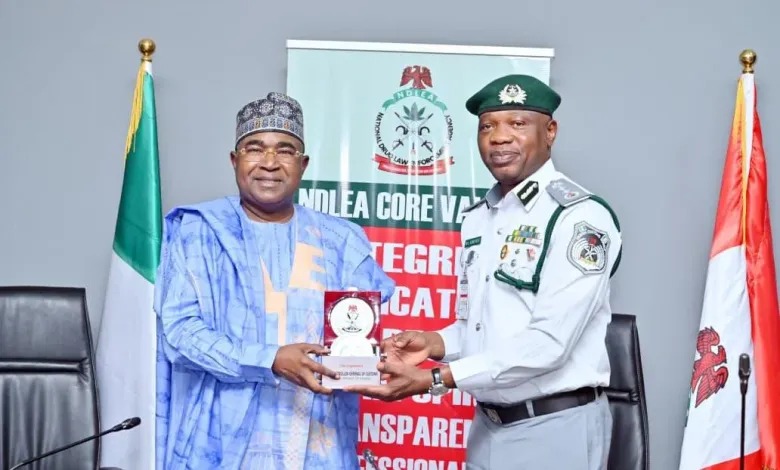
The agreement was sealed on Monday at the headquarters of the National Drug Law Enforcement Agency in Abuja, where its Chairman, Mohamed Buba Marwa, and the Comptroller-General of the Nigeria Customs Service, Bashir Adeniyi, signed a communiqué outlining a more coordinated national response to increasingly sophisticated criminal networks.
Both agencies warned that the surge in cross-border crime, particularly drug trafficking, has outpaced fragmented enforcement efforts, making deeper collaboration unavoidable.
Under the new framework, NDLEA and Customs will streamline intelligence sharing, eliminate operational duplication and mount joint enforcement actions across Nigeria’s seaports, airports and land borders. Central to the plan is the creation of joint task forces at critical entry points, alongside a secure platform for real-time intelligence exchange.
Officials said the initiative is designed to move both agencies from parallel operations to a more unified, intelligence-driven approach.
“This partnership marks a significant shift towards a seamless flow of intelligence and a more coordinated national response,” the agencies said in a joint statement, signalling a tougher stance against organised trafficking syndicates.
The agreement also provides for a standing inter-agency committee to resolve operational disputes and ensure sustained cooperation, while reaffirming respect for the distinct legal mandates of each organisation.
Marwa and Adeniyi described the pact as a strategic imperative, stressing that stronger collaboration would not only curb the inflow of illicit drugs but also reinforce Nigeria’s borders against wider transnational threats.
They maintained that the enhanced coordination would be carefully balanced to avoid disruptions to lawful trade and travel, even as enforcement is stepped up across key gateways into the country.