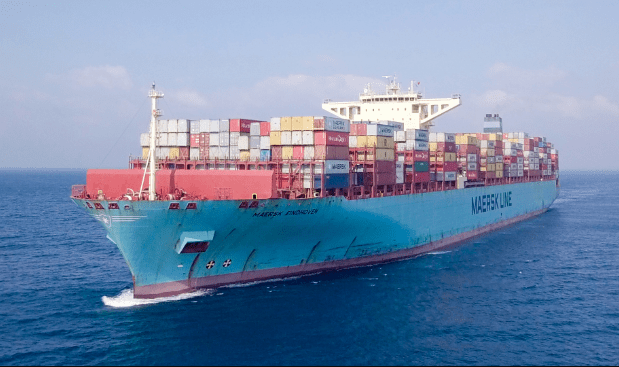
Maersk delivered a strong second quarter, driven by higher container volumes, rising Ocean spot rates and growth across its three core businesses, prompting the Danish shipping and logistics group to sharply raise its full-year earnings guidance.
Revenue rose 20% year on year to US$15.8 billion, while EBITDA increased to US$3 billion from US$2.3 billion.
EBIT almost doubled to US$1.6 billion, taking the group’s EBIT margin to 10%.
Ocean led the improvement, with revenue up 23% and EBIT reaching US$935 million, compared with US$229 million a year earlier and a US$192 million loss in Q1 2026.
Loaded volumes rose 4.1%, while average freight rates increased 22% and vessel utilisation reached 96%.
Maersk said strong demand, tighter capacity and increasingly unbalanced trade flows pushed spot rates higher. Congestion in Europe, the Middle East, West Africa and the East Coast of South America further tightened capacity.
Disruption around the Strait of Hormuz also reshaped cargo flows, with Gulf-bound shipments diverted through alternative ports and inland routes.
Demand remained particularly strong for imports into Africa, North America and Latin America, while exports from the Far East, especially China, continued to grow.
“The second quarter was yet another proof point of the new era of heightened volatility we have entered,” said Maersk chief executive Vincent Clerc.
Logistics & Services also strengthened, with revenue up 15% and EBIT rising to US$217 million from US$175 million.
Landside operations, forwarding and new logistics contracts supported the improvement.
Terminals delivered a solid performance, with volumes up 2.2% and revenue rising 11% to US$458 million in EBIT.
Maersk said the underlying performance offset the impact of the conflict in the Middle East.
The group also expanded its infrastructure footprint, inaugurating a US$350 million terminal at Suape in Brazil and agreeing to develop the more than US$1.7 billion Lien Chieu Container Terminal in Vietnam.
Maersk now expects underlying EBITDA of US$10.5 billion to US$12.5 billion in 2026, up from its previous US$8 billion to US$10 billion forecast.
Underlying EBIT guidance has been raised to US$4.5 billion-US$6.5 billion from US$2 billion-US$4 billion.
The company also expects positive free cash flow, compared with its previous forecast of at least negative US$1.5 billion.
The outlook assumes global container volume growth of around 4% for the year.
Clerc said Maersk’s ability to capture opportunities in volatile markets had delivered “significant volume and earnings growth”, supporting the substantial upgrade to its full-year guidance.