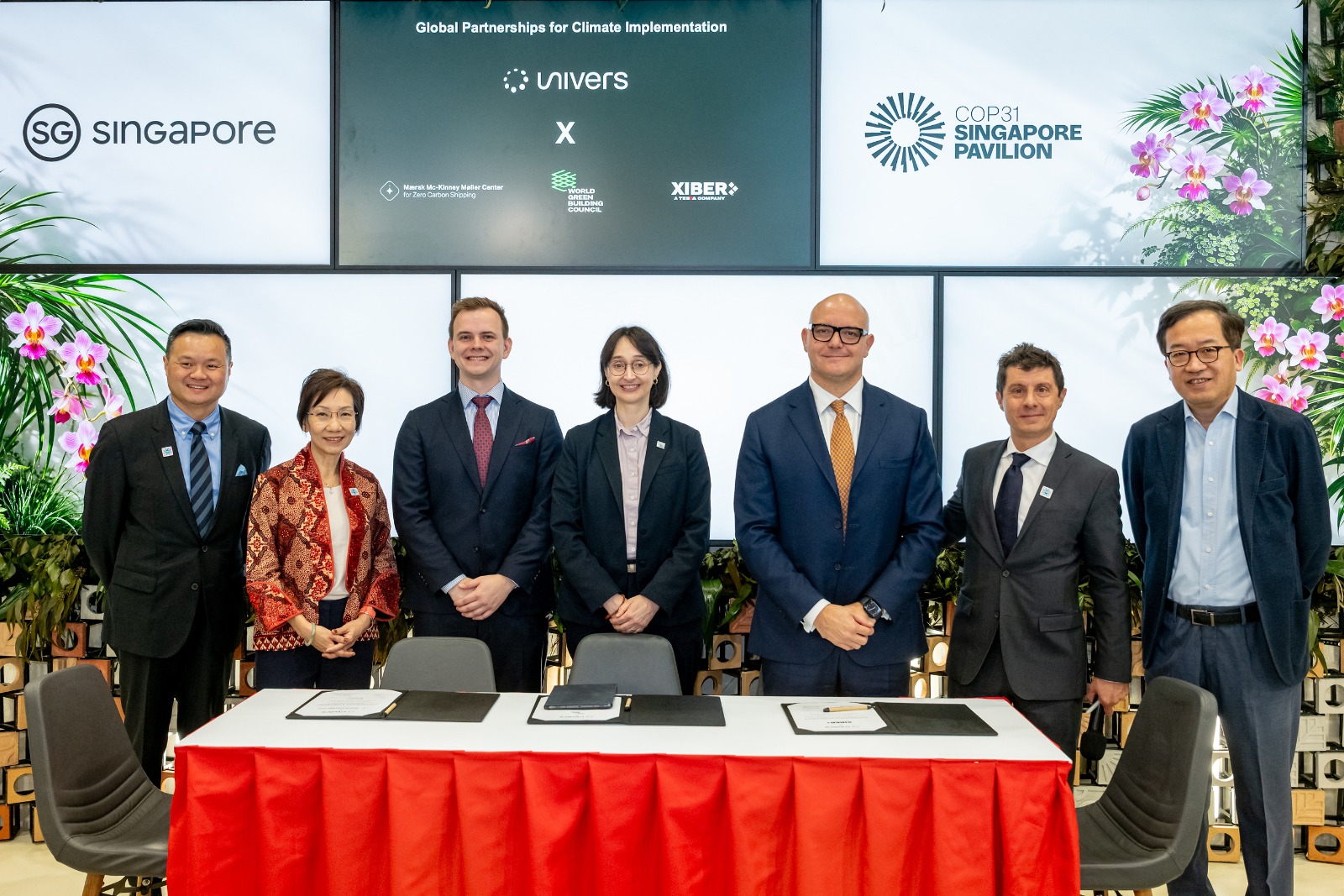
Singapore-based technology company Univers has partnered with the Mærsk Mc-Kinney Møller Center for Zero Carbon Shipping to explore how artificial intelligence can transform maritime operations and accelerate the shipping industry’s decarbonisation efforts.
The agreement was formalised at the Singapore Pavilion during COP31 in Antalya, Türkiye, as part of a series of strategic partnerships announced by Univers on Monday.
The collaboration will focus on how AI can improve operational decision-making across vessels, fuels, ports and the wider maritime supply chain, while unlocking economic and environmental benefits for the industry.
Under the agreement, Univers will become one of the Center’s early AI partners, bringing its expertise in integrating operational systems, data and artificial intelligence to support more efficient and sustainable maritime operations.
At the heart of the partnership is Univers’ newly introduced Return on Intelligence framework, designed to measure the business value generated by AI-powered decisions in physical operations.
Moving beyond conventional assessments of technical performance and emissions reductions, the framework examines the broader operational and financial gains that AI can deliver.
These include higher asset productivity, improved operational efficiency and new opportunities for business growth.
Univers has also unveiled a whitepaper, titled “Return on Intelligence: How AI Changes the Economics of Transport”, developed with contributions from the Mærsk Mc-Kinney Møller Center for Zero Carbon Shipping.
The publication examines how organisations can assess the economic and environmental value of integrating AI into transport operations, offering insights into the potential of intelligent technologies to reshape the economics of the sector.
Commenting on the partnership, Pernille Dahlgaard, Chief Impact Officer at the Mærsk Mc-Kinney Møller Center for Zero Carbon Shipping, said maritime decarbonisation required a coordinated, systems-wide approach.
“Maritime decarbonisation is a systems challenge. AI has the potential to connect decisions across vessels, fuels, ports and operations, translating intelligence into measurable operational, economic and environmental outcomes,” she said.
Univers’ Physical AI platform integrates operational technology, information systems and artificial intelligence to support the management of complex infrastructure.
The company sees significant potential for this approach in the maritime sector, where better coordination and more effective use of operational data could help shipping organisations enhance efficiency, optimise resources and advance their sustainability ambitions.
However, the partners are yet to disclose details of any specific vessel deployment, commercial implementation or timeline for introducing the technology into shipping operations.
The maritime partnership is part of Univers’ broader push to expand AI applications across the transport, energy and infrastructure sectors. During COP31, the company also announced separate collaborations with the World Green Building Council and XIBER Energy Solutions, underscoring its ambition to extend AI-driven solutions across critical industries.