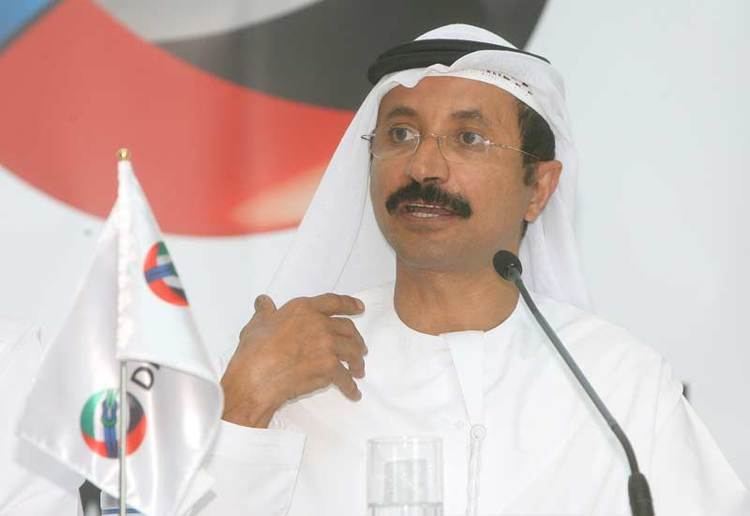
DP World has been thrust into global scrutiny after its long-serving chairman, Sultan Ahmed bin Sulayem, last week resigned with immediate effect following mounting controversy over alleged links to the Epstein files.
The abrupt departure of one of the maritime industry’s most influential figures has triggered a swift leadership reshuffle at the Dubai-based ports and logistics giant, with new appointments announced within hours.
In a disclosure to Nasdaq Dubai, DP World confirmed that “Group Chairman and CEO, Sultan Ahmed bin Sulayem has resigned from the company, effective immediately,” offering no further explanation. The statement’s brevity contrasted sharply with the scale of the change, bringing to a close a tenure that had defined the company’s rise into one of the world’s dominant port operators.
Shortly afterwards, Dubai’s Government Media Office announced that Essa Kazim had been appointed Chairman of DP World’s Board of Directors, while Yuvraj Narayan would assume the role of Group Chief Executive Officer. The official communication outlined the credentials of the incoming leadership but made no reference to the departing bin Sulayem, underscoring the sensitivity surrounding his exit.
Essa Kazim brings extensive experience in financial governance and national economic institutions. He currently serves as Governor of the Dubai International Financial Centre and Chairman of Borse Dubai, roles that have placed him at the centre of the emirate’s financial architecture. Officials described him as a seasoned figure in economic affairs whose leadership would reinforce strategic continuity and investor confidence at a moment of reputational challenge.
Narayan, the newly appointed chief executive, represents continuity from within DP World’s own ranks. A longstanding senior executive, he joined the group in 2004 and has served as Chief Financial Officer since 2005, playing a central role in its global expansion and financial strategy. His elevation signals an intention to maintain operational stability and strategic momentum despite the sudden change at the top.
The leadership transition follows intensifying attention on bin Sulayem’s name in connection with documents linked to the late sex offender Jeffrey Epstein. While details of the alleged associations have not been publicly elaborated in the company’s filings, the mere emergence of such links has proved sufficient to ignite reputational concerns for a corporation deeply embedded in global trade networks and public-sector partnerships. For DP World, whose operations span dozens of countries and whose projects often involve sovereign stakeholders, governance credibility and executive integrity are critical assets.
DP World emphasised in its announcement that the new appointments support its strategy for sustainable growth and reinforce its role in strengthening global supply chains while advancing Dubai’s position as a leading hub for trade and logistics. The wording suggests an effort to project continuity and confidence, reassuring markets and partners that operations and long-term strategy remain unaffected.
Bin Sulayem’s departure marks the end of an era for DP World. Under his leadership, the company expanded aggressively beyond port terminals into logistics, free zones, and integrated supply-chain services, transforming from a regional operator into a global maritime powerhouse. He was widely seen as a central architect of Dubai’s emergence as a premier trade and logistics centre linking Asia, Europe, and Africa. His sudden exit therefore carries implications not only for corporate governance but also for the broader narrative of Dubai’s state-linked commercial expansion.
The episode illustrates the growing influence of reputational risk in global commerce, particularly where corporate leadership intersects with geopolitical visibility and public accountability. In an era of heightened scrutiny, even indirect associations with controversial figures can prompt swift institutional responses.