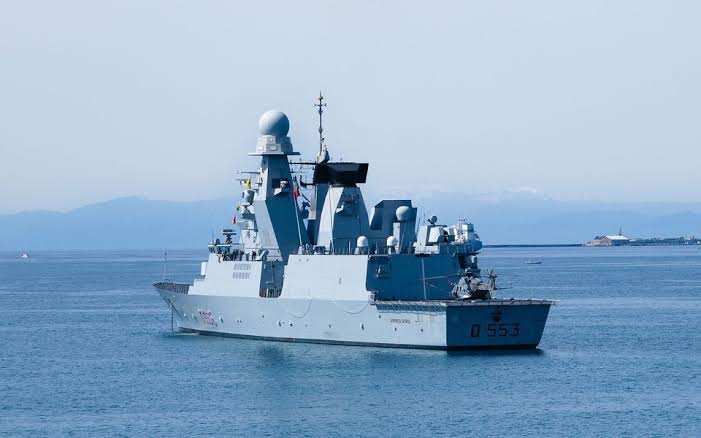
The European Union has agreed to prolong its maritime protection mission in one of the world’s most volatile shipping corridors, committing nearly €15 million to keep Operation ASPIDES at sea until 28 February 2027. The move underscores Europe’s determination to safeguard commercial traffic through waters that remain fraught with danger more than two years after attacks on merchant vessels began to rattle global trade.
The mission, formally known as EUNAVFOR ASPIDES, was launched in February 2024 after Iran-aligned Houthi forces intensified assaults on commercial shipping in late 2023. Its warships provide defensive escorts through the choke point of the Bab al-Mandab Strait and maintain surveillance across a vast arc of sea lanes spanning the Red Sea and Gulf of Aden to the Arabian Sea and the Strait of Hormuz.
Announcing the extension, EU officials said the decision reaffirmed Europe’s commitment to maritime security, regional stability and the protection of global trade flows. The renewal comes at a delicate juncture for container lines debating whether conditions are safe enough to resume transits via the Suez Canal after months of costly diversions.
Some carriers, including Maersk and Hapag-Lloyd, have begun cautiously steering services back towards the Red Sea for the first time in over two years, while rivals such as CMA CGM have again opted for the longer route around the Cape of Good Hope, a stark sign that industry confidence remains fragile.
Security dynamics are shifting further as the United States reinforces its naval presence. The aircraft carrier USS Abraham Lincoln and several guided-missile destroyers have moved into the area overseen by U.S. Central Command, with President Donald Trump describing an “armada” advancing towards Iran, a rhetoric that has heightened regional tensions and injected fresh uncertainty into shipping risk calculations.
The crisis gripping the Red Sea trade route erupted in November 2023 when Houthi forces seized the vehicle carrier Galaxy Leader. Since then more than one hundred merchant ships have been attacked, four sunk and one captured, with at least eight seafarers killed — a toll that continues to shadow every decision about returning to one of the world’s most critical maritime arteries.