The Council of the International Maritime Organization (IMO) has issued a strong condemnation of threats and attacks against vessels in the Strait of Hormuz, warning that the situation is endangering commercial shipping and the safety of seafarers.
In a statement aligned with UN Security Council Resolution 2817, the Council denounced the attacks and the purported closure of the strategic waterway, noting that the developments have adversely affected merchant shipping and placed crews at risk.
The Council stressed the need for an internationally coordinated response to maritime security in the region and reaffirmed that the navigational rights and freedoms of merchant vessels under international law must be respected.
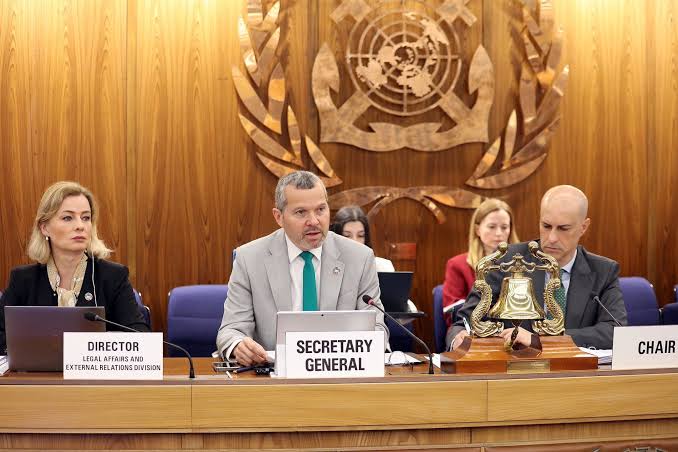
Closing the session, IMO Secretary-General Arsenio Dominguez urged governments and stakeholders to move beyond rhetoric and take decisive action. He said the responsibility lies with all parties to demonstrate that inaction is not an option and that words alone are insufficient. Only through collective action, he said, can the wellbeing of seafarers be protected and the principle of freedom of navigation safeguarded.
The Council called for the immediate halt of all attacks on ships affecting innocent civilian seafarers and urged states to ensure that vessels currently unable to leave the region continue to receive essential supplies, including water, food and fuel.
Member States were also encouraged to facilitate crew change and crew rotation in accordance with international standards to protect the health, safety and welfare of seafarers caught in the crisis. The Council emphasised that crews must be able to maintain communication with their families and that adequate provisions remain available on board.
Highlighting growing operational risks in the area, the Council warned that ships transiting the region are facing increasing pressure, including severe fatigue among crews and disruptions to navigation systems caused by widespread jamming and spoofing of Global Navigation Satellite Systems. It stressed that the master’s overriding authority must be respected while navigating such hazardous conditions.
As an urgent measure, the Council called for the creation of a provisional safe maritime framework to enable the evacuation of merchant vessels currently confined within the Gulf region. The proposed mechanism aims to protect seafarers and allow commercial ships to exit the area safely while avoiding military attacks.
The Council directed IMO Secretary-General Arsenio Dominguez to begin immediate efforts to establish the framework in cooperation with relevant stakeholders.
Dominguez said he was ready to begin negotiations at once to create a humanitarian framework that would enable the evacuation of vessels and crews trapped in the region. However, he warned that the initiative would only succeed with the understanding, commitment and concrete action of all countries and parties involved.