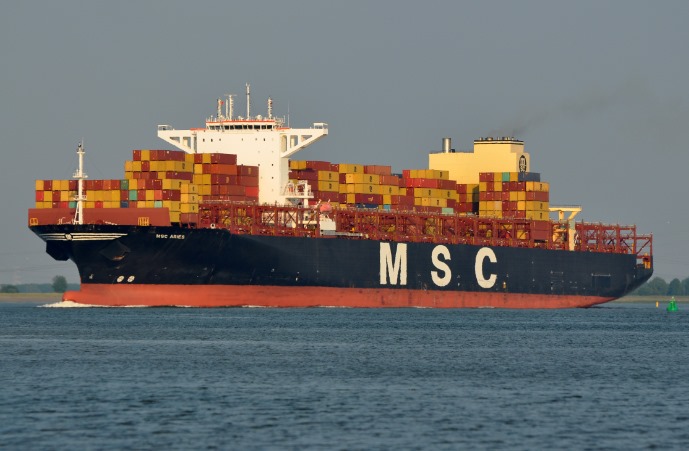
Geneva-based Mediterranean Shipping Company (MSC) has crossed another historic threshold, pushing its total containership capacity beyond 7.2 million TEU and reinforcing its status as the world’s largest container carrier.
According to maritime analyst Alphaliner, MSC now commands a formidable 21.4 per cent share of the global container fleet — a level of dominance unmatched in the industry’s history.
The scale of MSC’s fleet continues to expand at striking speed. The company currently operates 980 vessels in active service, drawing ever closer to the symbolic milestone of 1,000 ships. Of these, 727 vessels with a combined capacity of 4.55 million TEU are owned outright, while 253 ships totalling 2.65 million TEU are chartered.
MSC also holds an orderbook of 2.18 million TEU, giving it one of the most substantial forward growth pipelines among the world’s top carriers and placing it fourth in orderbook-to-fleet ratio within the leading ten.
This latest achievement marks another stage in MSC’s remarkable ascent since January 2022, when it overtook Danish rival A.P. Moller-Maersk to claim the number-one position after decades of Maersk leadership. At that moment, MSC’s fleet capacity stood at 4,284,728 TEU — only 1,888 TEU ahead of Maersk — with both companies holding roughly 17 per cent of global capacity. The narrow margin hinted at a rivalry entering a new era.
In the years that followed, MSC decisively widened the gap, becoming in 2024 the first container line ever to surpass a 20 per cent market share, eclipsing Maersk’s previous record of 19.4 per cent set in 2018.
The shift marked the end of an era. Maersk had long been synonymous with container shipping leadership, having entered the containerised trade in 1975 and built a reputation for technological ambition and record-breaking ship size.
In recent years the Danish group has also focused on decarbonisation, investing heavily in vessels capable of operating on carbon-neutral fuels in anticipation of tightening environmental regulation. Even so, MSC’s aggressive capacity expansion and opportunistic chartering strategy transformed competitive dynamics across the sector.
Despite surrendering the overall capacity crown, Maersk retains an advantage in ownership structure. MSC’s growth has relied significantly on chartered tonnage, with roughly 65 per cent of its capacity tied to chartered ships, compared with Maersk’s 42 per cent. This difference reflects contrasting philosophies: MSC has pursued rapid scale and market reach, while Maersk has emphasised asset control and integrated logistics services.
Leadership has also played a notable role in MSC’s rise. Since 2020 the company has been headed by Søren Toft, formerly a senior Maersk executive widely viewed as a potential successor within the Danish group before his high-profile move to MSC. Under his tenure, MSC has accelerated fleet expansion, strengthened global networks, and consolidated its commanding market position.
The company’s surge has unfolded against the backdrop of dramatic upheaval in global container shipping since the COVID-19 pandemic. A sudden surge in consumer goods demand strained vessel capacity and drove freight rates to extraordinary heights, with the Shanghai Containerised Freight Index recording an 81 per cent rise in 2021.
The period reshaped trade patterns, profitability, and competitive strategies across the industry, enabling large carriers with access to tonnage and capital to expand aggressively. MSC proved particularly adept at seizing this moment, acquiring second-hand ships and chartering vessels at scale while competitors hesitated.
Today, MSC’s approach has yielded an unprecedented concentration of capacity in a single carrier’s hands. Approaching the 1,000-ship mark and holding more than a fifth of global container capacity, the company stands not merely as the world’s largest shipping line but as a defining force in the modern maritime economy.
Its continued expansion signals that the competitive contest in container shipping is no longer simply about size, but about how scale is leveraged in an era of volatile trade demand, environmental transition, and evolving logistics networks.