The Nigerian Maritime Administration and Safety Agency (NIMASA) is weighing plans to expand the Deep Blue project to ensure its long-term sustainability and deepen its impact across the Gulf of Guinea.
The Deep Blue Project, formally known as the Integrated National Security and Waterways Protection Infrastructure, was conceived to address piracy, sea robbery, illegal fishing and other maritime crimes in Nigeria’s waters and the wider Gulf of Guinea.
Conceived by former Minister of Transportation, Rotimi Amaechi, and launched by late President Muhammadu Buhari in 2021, the initiative integrates air, land and sea assets, supported by advanced surveillance technology and a command-and-control centre, to provide round-the-clock maritime domain awareness.
Since its deployment, the project has been credited with a significant decline in piracy incidents and has positioned Nigeria as a leader in maritime security cooperation in West and Central Africa.
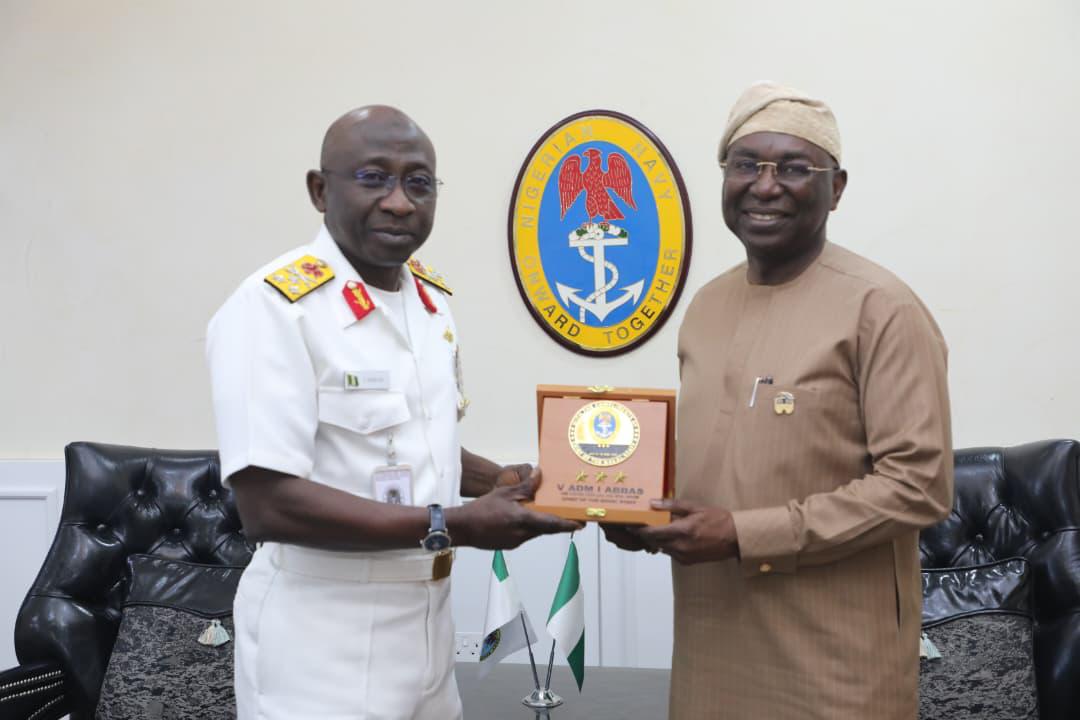
The Director General of NIMASA, Dr Dayo Mobereola, revealed plans for the project’s expansion during a strategic visit to the Chief of Naval Staff, Vice Admiral Idi Abass, at the Naval Headquarters in Abuja.
He applauded the Nigerian Navy for its strong and harmonious collaboration with the agency, while also congratulating Vice Admiral Abass, who previously served as Maritime Guard Commander under NIMASA, on his appointment.
Mobereola stressed the need to sustain and further strengthen the partnership between both institutions, noting that collaboration has been central to the success of the Deep Blue Project.
He explained that the visit was not only to congratulate the naval chief, but also to deliberate on how the initiative could be sustained, expanded and made more impactful across the Gulf of Guinea.
Expressing confidence in high-level support, he said NIMASA was working towards presenting proposals for necessary improvements with the backing of the Minister of Marine and Blue Economy, and the Nigerian Navy.
Highlighting the project’s global resonance, the NIMASA boss said the Deep Blue project had earned commendation from the International Maritime Organisation, with several African countries and others beyond the continent seeking to replicate Nigeria’s approach.
In his response, Vice Admiral Abass welcomed the NIMASA delegation and commended the agency for its contributions to the maritime sector and its consistent support for the navy.
He reaffirmed his commitment to inter-agency cooperation, noting that collaboration remained essential to achieving national objectives and that both organisations naturally complemented each other.
The naval chief, however, raised concerns about the Memorandum of Understanding between NIMASA and the Nigerian Navy, which has been in place since 2007, calling for its review to reflect current realities.
He also urged NIMASA to make greater use of the navy’s capacity in areas such as vessel repairs, hydrographic surveys and charting.
Additionally, he sought the agency’s assistance with wreck removal, particularly as the Navy prepares to host foreign vessels during activities marking its forthcoming 70th anniversary celebrations.