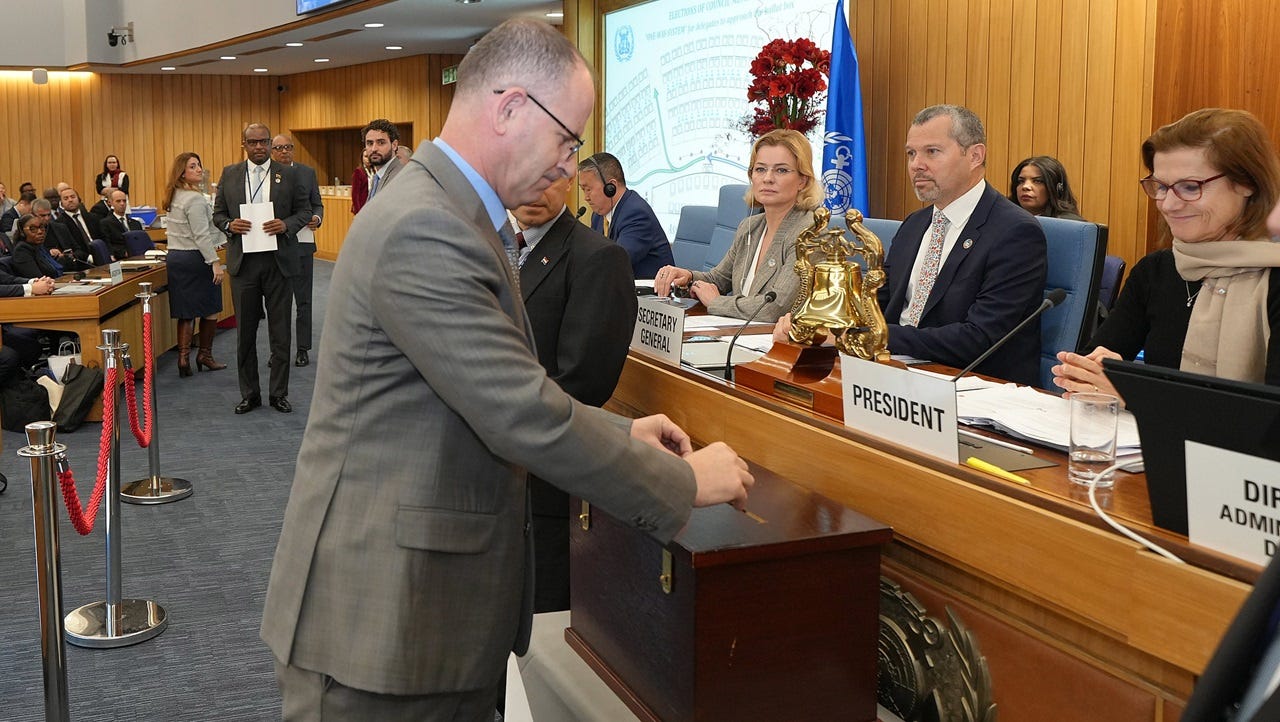
Russia suffered a significant diplomatic setback last Friday in London when it failed to secure re-election into Category A of the International Maritime Organization (IMO) Council, a development widely interpreted as a direct consequence of its war in Ukraine and the resulting strain in its relations with much of the international community.
Eleven IMO Member States contested for the ten available seats in Category A, which is reserved for nations with the largest interest in providing international shipping services.
Russia, which had previously served on the Council until 2023, was the only country that was not elected, securing just 87 votes out of 170 in what diplomats described as a dismal showing.
Before the voting began, the Ukrainian delegation was given the floor and delivered a sharply critical address condemning Russia’s invasion of their territory, highlighting the loss of lives and the continuing humanitarian toll of the conflict, as well as its destabilizing effects on global shipping routes and maritime security.
The remarks, which attendees described as damning and unflinching, set a sombre tone and reinforced the concerns of many Member States. The final results underscored Russia’s isolation as China, Greece, Italy, Japan, Liberia, Norway, Panama, Korea, United Kingdom and United States of America were elected into the Category A of the IMO Council for the 2026-2027 biennium with votes ranging from 141 to 154, while Russia came last with 87 votes and consequently lost its seat for the second consecutive term.
The outcome is widely seen as another sign of the international community’s ongoing pushback against Russia over its actions in Ukraine.
The election into Category B, which features countries with the largest interest in international seaborne trade, produced another casualty in Argentina. Although eleven countries contested, only ten could be elected.
India topped the group with 154 votes, followed by Spain and the United Arab Emirates with 148 each, Germany with 146, Brazil with 145, France and Sweden with 143 apiece, the Netherlands with 141, Canada with 135 and Australia with 134. Argentina, which received 125 votes and placed eleventh, was not elected.
Category C, which comprises nations with special interests in maritime transport or navigation, recorded a more competitive field as twenty-six countries vied for twenty seats. Bangladesh, Denmark, Kenya, Pakistan and Thailand were among those that missed out.
The countries elected were Bahamas, Belgium, Chile, Cyprus, Egypt, Finland, Indonesia, Jamaica, Malaysia, Malta, Mexico, Morocco, Nigeria, Peru, Philippines, Qatar, Saudi Arabia, Singapore, South Africa and Türkiye.
For Nigeria, the election marked a particularly noteworthy milestone, as the country reclaimed its seat on the IMO Council after a fourteen-year absence.
Russia’s failure to regain its Category A seat is viewed as a continuation of its diplomatic isolation since the invasion of Ukraine.
The results of the elections highlight how geopolitical tensions are increasingly shaping decisions within global maritime governance and reflect the shifting mood of the international maritime community.
The newly elected Council will meet for its 136th session on 4th December and will elect its Chair and Vice-Chair for the next biennium.