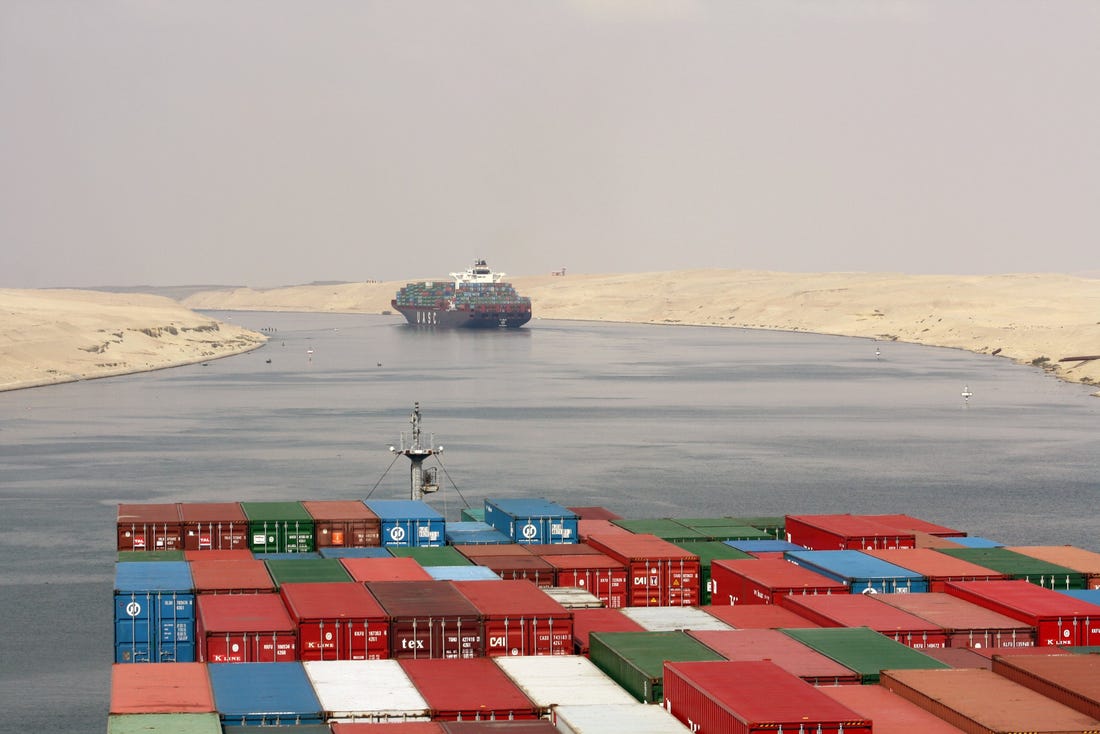
Containership traffic through the Suez Canal is beginning to stir again, offering a cautious glimmer of revival for a trade route that has stood largely silent since late 2023.
In the past week, 26 containerships transited the canal, the highest weekly total in more than a month, according to Drewry’s newly launched Red Sea Diversion Tracker. While modest by historical standards, the figure marks a notable step up for a passage that once carried a major share of global trade but has been shunned amid persistent security fears.
The increase follows a particularly quiet prior week, when only 10 vessels passed through in the wake of post-Christmas slowdowns.
This time, however, the composition of traffic tells a more significant story. Drewry reports that CMA CGM, APL and MSC sent five ships larger than 8,000 TEU through the canal, more than double the previous week’s total.
Smaller regional operators never fully abandoned Suez, but the return of major global carriers signals the strongest indication yet that the industry is testing whether the Red Sea route can be safely reopened.
Before the crisis, around 80 containerships routinely passed through the canal each week, carrying roughly 12 per cent of global seaborne trade between Asia and Europe. That flow collapsed after Houthi forces in Yemen began attacking commercial shipping in October 2023, prompting carriers to reroute thousands of miles around the Cape of Good Hope.
Since then, more than 100 merchant vessels have been targeted, four sunk, one seized and at least eight seafarers killed.
Now some of the world’s biggest operators are cautiously edging back. Maersk recently completed its second Red Sea transit since the attacks began, with the U.S.-flagged Maersk Denver passing safely through the strait on its Middle East–US East Coast service.
It followed the December transit of the Maersk Sebarok, the company’s first Suez passage in more than a year. Maersk has stressed that any broader return will remain gradual and dependent on safety conditions.
CMA CGM appears more willing to accelerate its comeback. The French carrier has outlined plans to resume Suez transits on its India–US INDAMEX service and, in late December, sent the 23,000-TEU CMA CGM Jacques Saade through the canal, the largest ship to do so in two years.
Yet caution still dominates the industry’s strategy. Drewry data shows that 203 voyages rounded the Cape of Good Hope in the same week, more than twice the number recorded a week earlier. The continued preference for the longer route underlines the lingering doubts over security in the Red Sea.
Drewry’s Philip Damas described the reopening of Suez as one of the key variables shaping global shipping this year, influencing capacity, freight rates and transit times.
He expects carriers to watch insurance costs, competitors’ decisions and the risk of European port congestion before committing fully to the route.
For Egypt, a full recovery cannot come soon enough. Canal tolls remain a critical source of foreign currency, and Suez Canal Authority chairman Admiral Ossama Rabiee has said he hopes traffic will return to normal levels by the second half of 2026. Until then, the world’s most famous maritime shortcut remains open, but still on cautious trial.