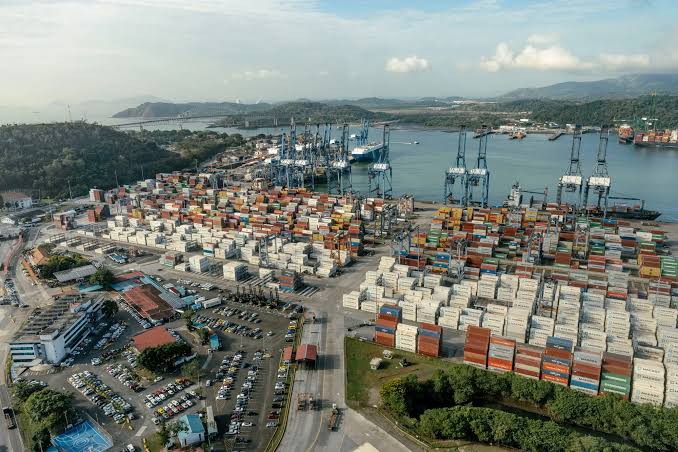
Panama has moved swiftly to secure the uninterrupted functioning of its vital canal gateway ports after the country’s Supreme Court annulled long-standing concessions held by Hong Kong–based conglomerate CK Hutchison, bringing an end to nearly three decades of private operation at the Atlantic and Pacific entrances to the interoceanic waterway.
The ruling, now formally enacted following its publication in the official gazette, is final and not subject to appeal. It hands operational authority over the ports of Balboa and Cristóbal to the Panamanian state, with the Panama Maritime Authority confirming that it has taken possession of the facilities and instituted transitional management arrangements to ensure continuity.
Ports director Max Flórez told reporters that the authority has assumed control and guaranteed ongoing operations, adding that an 18-month transition period has begun during which new international concessions will be prepared and awarded.
The decision reverberates far beyond Panama’s shores. The Panama Canal handles roughly 40 per cent of United States container traffic and about five per cent of global trade, making any shift in governance at its terminals geopolitically sensitive. The Central American nation has increasingly found itself caught in the cross-currents of US–China rivalry, intensified by claims last year from US President Donald Trump that China effectively controlled the canal — an assertion Panama has consistently rejected.
The 80-kilometre waterway, built by the United States and transferred to Panamanian sovereignty in 1999, remains used predominantly by American and Chinese shipping interests.
At the centre of the legal dispute are the concessions granted to CK Hutchison to operate the Balboa terminal on the Pacific side and Cristóbal on the Atlantic. In January, Panama’s Supreme Court declared the contracts unconstitutional, a judgement that has now culminated in the state’s repossession of the ports.
CK Hutchison had sought negotiations with Panama to maintain operations, warning that failure to do so could trigger operational disruption. The company has since indicated it may pursue arbitration at the International Chamber of Commerce and has cautioned of possible legal action against incoming operators.
To stabilise the transition, Panama has designated experienced global terminal operators to manage the ports on an interim basis. APM Terminals, part of the Danish Maersk Group, will run Balboa, while Terminal Investment Limited, backed by Mediterranean Shipping Company (MSC), will take over Cristóbal.
Authorities have sought to reassure workers and the wider logistics community, with Labour Minister Jackeline Muñoz pledging that there will be no redundancies among the approximately 1,200 employees at the two terminals.
The unfolding episode underscores both the commercial significance and geopolitical sensitivity of canal operations in an era of intensifying maritime competition.
US Ambassador to Panama Kevin Cabrera publicly supported Panama’s actions, noting that the country has the sovereign right to allow its judicial system to reach independent decisions.