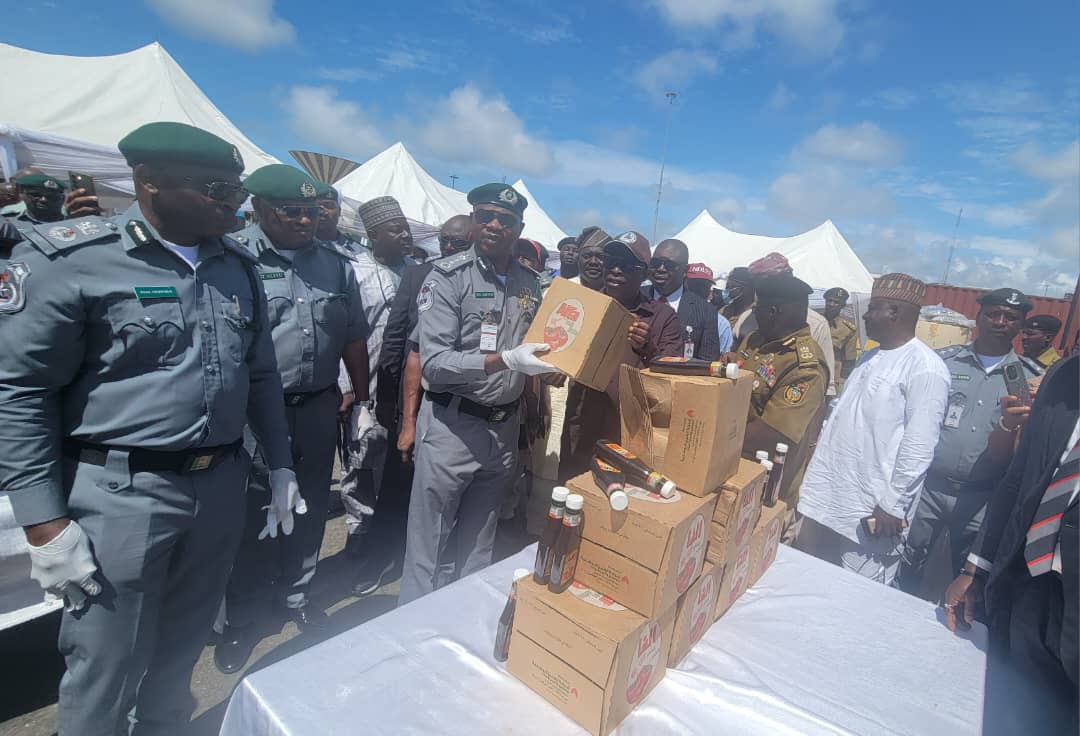
The Nigeria Customs Service has seized prohibited and expired goods worth ₦43.59 billion, including 7,624 kilogrammes of cannabis sativa, 169,998 bottles of codeine syrup and 108 high-definition dual-camera drones.
The Comptroller-General of Customs, Adewale Adeniyi, announced the seizures at a press briefing on operations at the Apapa Area Command, saying they were secured through intelligence-led cargo profiling, risk assessment, document checks and targeted examinations.
Adeniyi said criminal networks were increasingly hiding illicit goods in legitimate consignments, making intelligence-driven enforcement critical.
“Narcotics are packed among vehicle spare parts and used vehicles. Controlled drugs travel beneath household goods. Restricted equipment is declared as ordinary electronics,” he said.
Three containers — HAMU 3086682, FANU 1933352 and MSKU 3941778 — were found to contain cannabis weighing 2,388.5kg, 4,145kg and 1,090.5kg respectively. The drugs were concealed alongside vehicles, automobile spare parts, food products, batteries and other goods.
Customs also intercepted 1,700 cartons containing 169,998 bottles of codeine syrup in a 40-foot container, TCKU 7653306, where the drugs had been hidden beneath household items.
Adeniyi described the seizure as a major blow to the illicit drug supply chain, warning of the serious consequences of codeine abuse, particularly among young Nigerians.
The NCS also seized 108 dual-camera drones from container MSKU 9282528. Adeniyi warned that security-sensitive equipment imported without the required approvals, end-user certificates and documentation would be detained.
Five containers carrying expired products, including tomato ketchup, antiseptic liquid, vaginal tablets and disposable nappies, were also intercepted, alongside three containers containing 1,282 bales of used clothing.
The Customs chief said the seizures followed collaboration with the National Drug Law Enforcement Agency (NDLEA), NAFDAC, the Office of the National Security Adviser and international security partners.
He assured legitimate traders that the service’s risk-based approach would facilitate compliant commerce while targeting high-risk consignments.
Adeniyi warned importers against concealment, false declaration, undervaluation and prohibited imports, stressing that Nigerian ports would not become safe havens for illicit trade.
“Compliance is not an obstacle to business; it is an advantage over competitors who lack it,” he said.