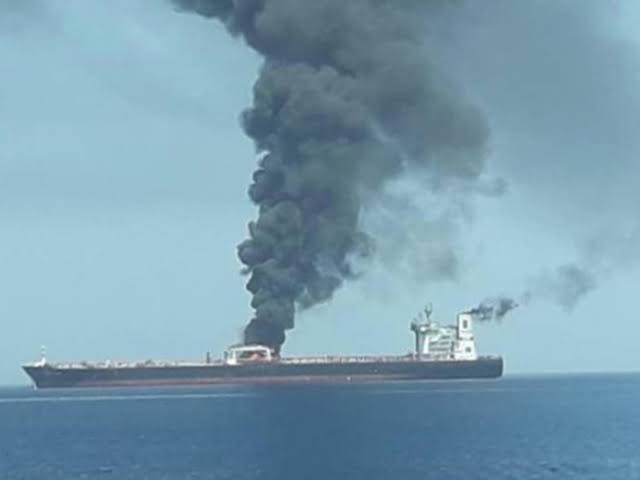
Two more tankers have been struck while transiting the Strait of Hormuz, leaving two seafarers injured and extending a sharp run of attacks against commercial shipping through the strategic waterway.
UK Maritime Trade Operations (UKMTO) said on Monday that military authorities reported an inbound tanker had been hit by an unknown projectile while passing through the strait.
Two crew members suffered minor injuries, but the vessel remained under its own power and continued towards its next port of call. No environmental impact was reported.
Hours later, UKMTO issued a second warning involving an LPG tanker making an outbound transit. The master reported that the vessel had been struck by debris from unknown projectiles.
All crew members were safe, no environmental impact was reported and the tanker continued its voyage.
Authorities are investigating both incidents.
The latest reports add to a sharp increase in attacks documented by UKMTO over the past week.
A Joint Maritime Information Center (JMIC) advisory issued on Sunday recorded three attacks in the Strait of Hormuz between 16 and 18 September, including an incident in which a tanker was struck by a projectile that breached its hull and sparked a fire.
That brings the number of reported attacks or security incidents involving tankers in the strait to at least five since 16 September.
JMIC continues to rate the threat level in the Strait of Hormuz as “severe”, saying deliberate hostile action is considered “highly likely” under current conditions.
The centre said attacks, attempted attacks and harassment by Iran’s Islamic Revolutionary Guard Corps have continued, including unmanned aerial vehicle overflights, surveillance of merchant vessels and VHF radio hailing.
UKMTO has not attributed either of Monday’s incidents, however, and described the projectiles involved as unknown.
The renewed attacks come as commercial traffic through the Strait of Hormuz remains far below normal levels.
Just 17 commodity vessels were visible transiting the strait over the weekend, down from 37 a week earlier and compared with roughly 125 vessels a day before the war.
The figures do not capture vessels travelling with their automatic identification system (AIS) transponders switched off.
JMIC has highlighted the same gap between visible and facilitated traffic. Independent tracking showed single-digit transits in both directions on some days, while US Naval Cooperation and Guidance for Shipping data indicated flows averaging more than 30 vessels a day during the 72 hours leading up to Sunday.