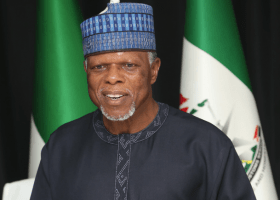
The Comptroller-General of the Nigeria Customs Service, Bashir Adeniyi, has warned officers of the Customs Police Unit against abuse of power, stressing the need for discipline, accountability and strict adherence to the rule of law.
Adeniyi gave the warning on Thursday in Abuja at the opening of the inaugural Customs Police Summit, with the theme, ‘Reimagining Customs Policing: Learning from the Past, Responding to the Present and Preparing for the Future’.
He said the service could only effectively facilitate legitimate trade and combat illicit activities if its enforcement officers upheld the highest standards of integrity and professionalism.
Established in 2019, the CPU was mandated to investigate errant personnel, prevent crime and ensure compliance. Adeniyi stressed that its founding principle remained unchanged: no officer was above the law.
He identified integrity, restraint and accountability as essential to effective policing, warning that the extensive powers granted under the NCS Act 2023 must never be exercised arbitrarily.
“Every search, arrest and detention must rest on lawful grounds and withstand public and judicial scrutiny,” he said.
While commending officers for building the unit over the past seven years, the Comptroller-General warned that criminal networks were becoming increasingly sophisticated, exploiting legitimate trade routes and digital platforms to traffic firearms components, narcotics, counterfeit medicines, protected wildlife and illicit funds.
He said tackling these threats required intelligence-led operations, stronger inter-agency cooperation and effective use of technology rather than excessive enforcement.
“Our answers must be smarter. They must not be harder,” he said.
Adeniyi, who also chairs the World Customs Organisation (WCO), highlighted the importance of global instruments, including the SAFE Framework, Authorised Economic Operator programmes and Time Release Studies, in strengthening compliance and addressing security risks.
He described data as one of the Service’s most valuable assets, noting that digital platforms had improved cargo declarations, valuation, risk management and audit processes. He also cited the Interpol Data Centre and customs equipment as vital resources for intelligence-driven operations.
To reposition the CPU, he identified consolidation, collaboration and innovation as three key priorities. These include standardising arrest, detention and investigation procedures, strengthening professional training and ensuring that cases are properly prepared for prosecution.
He urged the unit to deepen cooperation with the Nigeria Police Force, Armed Forces, Economic and Financial Crimes Commission (EFCC), National Drug Law Enforcement Agency (NDLEA), National Agency for Food and Drug Administration and Control (NAFDAC) and Department of State Services (DSS).
“No single institution can defeat illicit trade alone, and partnership rests on trust that is earned through our conduct,” he said.
He also advocated the deployment of artificial intelligence, advanced scanners, geospatial tools and electronic cargo tracking to strengthen investigations, while cautioning that technology must be guided by data protection safeguards, human oversight and the rule of law.