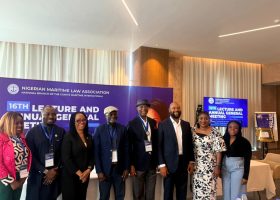
The Nigerian Maritime Law Association (NMLA) is set to bring key players in Nigeria’s maritime industry together in Lagos on 13 and 14 November 2026 for its 17th Lecture and Annual General Meeting, with a strong focus on positioning the country as a competitive force in the global maritime economy.
The two-day event, holding at the Radisson Blu Anchorage Hotel, Victoria Island, Lagos, will explore the theme, “Positioning Nigeria for Global Maritime Competitiveness: Law, Policy and Practice”, amid growing calls for stronger regulation, increased private investment and far-reaching reforms across the country’s maritime sector.
Professor Bongo Adi, Professor of Economics and Data Analytics at Lagos Business School, Pan-Atlantic University, will deliver the keynote address, setting the tone for discussions on the economic and policy imperatives of building a more efficient, attractive and globally competitive maritime industry.
The conference will tackle three critical issues confronting the sector: access to finance, port development and the modernisation of shipping laws.
The first panel, themed “Bankability of the Nigerian Maritime Industry: What Do Lenders Really Want?”, will examine why financing remains a major consideration for maritime businesses and what operators must do to attract capital from financial institutions. The discussion will feature banking, legal and industry professionals, including Moyomade Akinyosoye of Sterling Bank, Yewande Senbore of Olaniwun Ajayi LP, Ogonnaya Emele of Tetra Maritime Limited and Chibueze Muobuikwu of First Bank of Nigeria Limited. Ugochukwu Eze, Managing Partner of EaglEx Law Practice, will moderate.
Attention will then shift to the future of Nigeria’s ports, with the second panel examining “Port Concessions 2.0: Economic Regulation, Private Capital, and the Next Phase of Nigerian Port Development.” The session will interrogate the role of private investment, regulatory oversight and institutional accountability in delivering more efficient ports capable of supporting Nigeria’s trade ambitions. Speakers include Leonard Onoja of the Nigerian Ports Authority, Ben Unaegbunam of Dentons ACAS-Law, Joy Bridget Dimka of the Nigerian Ports Economic Regulatory Agency and Olayinka Akinlade of APM Terminals. Tunji Adeyemi of Banwo & Ighodalo will moderate.
The third panel will address the legal foundations of the industry under the theme “The Merchant Shipping Reset: Modernising Ship Registration, Liability, and Enforcement for a New Trade Era.” Discussions will centre on the need to update Nigeria’s shipping laws, strengthen ship registration and improve enforcement mechanisms in line with the demands of contemporary international trade. The panel will feature Victor Onyeagbado of Akabogu and Associates, Dianne Ndiomu of NIMASA and Faridah Orimobi of LATC, with Emeka Opara of Kenna as moderator.
The choice of topics reflects the interconnected challenges facing Nigeria’s maritime industry, where inadequate financing, port inefficiencies and regulatory gaps continue to shape the sector’s growth prospects.
For an industry central to international trade and economic development, stakeholders increasingly recognise that Nigeria’s maritime ambitions will require more than its strategic coastal location and vast commercial potential. Predictable laws, effective institutions, investor confidence and modern infrastructure will be equally decisive.
The NMLA’s 17th Lecture and AGM is therefore expected to provide an important platform for industry leaders, policymakers, legal practitioners, regulators and investors to confront these challenges and explore practical solutions.
Registration is open to members and non-members, with fees ranging from ₦195,000 to ₦450,000, depending on the category and registration period.
Further information is available at www.nmlang.com or through [email protected] and [email protected].
As Nigeria seeks a stronger foothold in the global maritime market, the conversations in Lagos could help shape the legal, financial and policy direction of the industry.