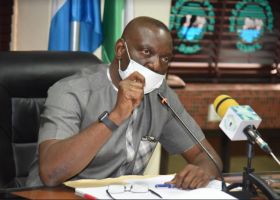
The President of the Port Management Association of West and Central Africa (PMAWCA), Dr Abubakar Dantsoho, has urged port authorities across the region to ditch unhealthy competition and embrace strategic collaboration to reduce cargo clearance delays, lower logistics costs and strengthen regional trade.
Dantsoho, who is also the Managing Director of the Nigerian Ports Authority (NPA), made the call at the opening ceremony of the 46th Annual Council and Joint Gulf of Guinea Commission-PMAWCA Forum in Sipopo, Malabo, Equatorial Guinea.
He said closer cooperation among regional ports was essential to overcoming structural challenges in the maritime industry, improving operational efficiency and enhancing the global competitiveness of West and Central African economies.
The PMAWCA president noted that the region’s Atlantic coastline, stretching from Mauritania to Angola, serves about 20 coastal countries, while five landlocked nations — Mali, Burkina Faso, Niger, Chad and the Central African Republic — rely heavily on its ports and transport corridors to access international markets.
He warned that inefficiencies at one port could trigger far-reaching economic consequences across neighbouring countries, particularly landlocked nations whose businesses and consumers depend on reliable maritime transport networks.
“When a single port along our coast suffers congestion, it is a household or a market in Bamako, Niamey, N’Djamena, or Bangui that bears the cost,” he said.
While acknowledging the significant transformation of West and Central African ports through investments in deep-sea terminals, public-private partnerships and modern infrastructure,
Dantsoho identified prolonged cargo dwell times, high port charges, expensive inland transportation and poor interoperability among customs administrations as major obstacles to regional trade.
He also expressed concern over the inability of existing digital platforms to support seamless information exchange between neighbouring ports and hinterland administrations, warning that the lack of integration continued to undermine efficiency across the regional maritime logistics chain.
According to him, the financial demands of dredging, infrastructure maintenance and equipment renewal also remain beyond the internal financing capacity of several port authorities.
Dantsoho further cautioned that geopolitical disruptions along major international shipping routes were placing additional pressure on regional port infrastructure, as changing global shipping patterns increasingly redirected maritime traffic towards the West and Central African coastline.
He described the development as a double-edged opportunity, noting that increased vessel calls could strengthen the region’s position in global maritime trade but also expose infrastructure gaps and existing capacity limitations.
Beyond operational challenges, he identified climate change, rising sea levels, coastal erosion, maritime decarbonisation requirements and cybersecurity threats as emerging risks that demand coordinated regional responses.
He warned that port authorities must prepare for the global energy transition and increasingly stringent environmental regulations or risk losing their competitiveness and relevance in international shipping networks.
To address these challenges, the PMAWCA president advocated a shift from destructive rivalry to strategic complementarity, arguing that cooperation among neighbouring ports would provide alternative operational capacity during emergencies, minimise disruptions and improve the reliability of cargo movement.
He stressed that resilience must go beyond constructing new terminals and expanding infrastructure to include preventive maintenance, stronger digital security and climate-proof investments.