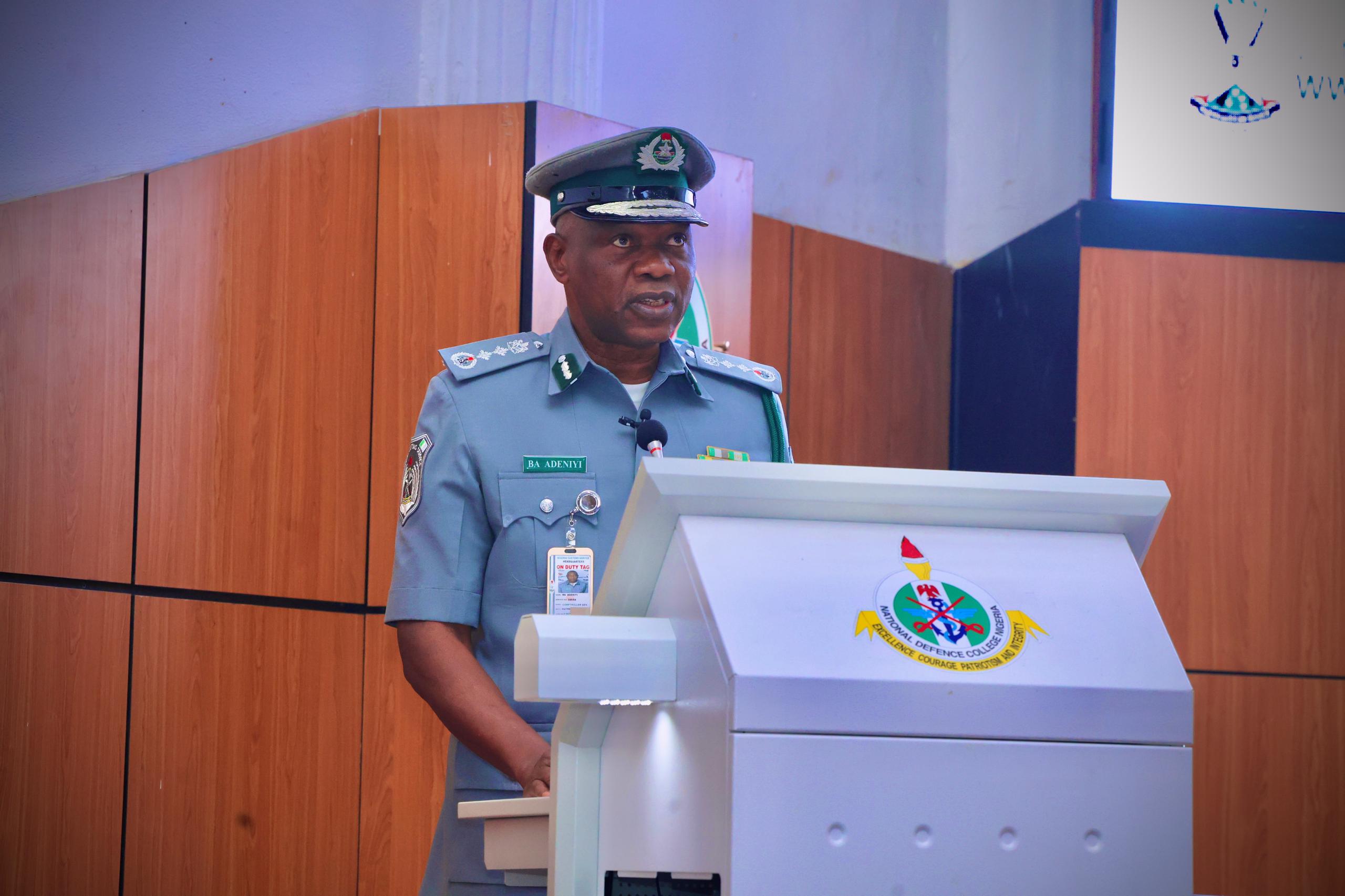
The Nigeria Customs Service (NCS) has set an ambitious revenue target of N11.074 trillion for the 2026 fiscal year, buoyed by its record-breaking performance in 2025 when it exceeded its revenue target by 10.24 per cent.
Comptroller-General of Customs, Adewale Adeniyi, disclosed this on Monday while defending the Service’s 2025 budget performance and presenting its 2026 revenue and expenditure estimates before the Senate Committee on Customs, Excise and Tariff, chaired by Senator Isah Jibrin.
Adeniyi said the Service generated N7.277 trillion in 2025, surpassing its revenue target of N6.584 trillion by N674 billion, underscoring the impact of ongoing reforms aimed at improving revenue collection and trade facilitation.
He also revealed that Customs had generated N4.43 trillion as of 31 May 2026, expressing confidence that the Service would achieve, and possibly exceed, its 2026 revenue target despite persistent global economic headwinds.
According to him, the projected N11.074 trillion revenue comprises N5.542 trillion for the Federation Account, N1.491 trillion for non-Federation accounts, N2.773 trillion from Import Value Added Tax (VAT) and approximately N1.266 trillion from the four per cent Free-on-Board (FOB) levy.
To support its operations, the Service has proposed a 2026 expenditure budget of N1.235 trillion, comprising N421 billion for personnel costs, N307 billion for overheads and N565 billion for capital projects.
Adeniyi, however, cautioned that recent Federal Government fiscal measures, particularly reductions in import tariffs and levies on new and used vehicles, could dampen Customs revenue.
He explained that the revised tariff regime, which came into effect on 1 May 2026, was designed to stimulate trade and reduce costs for importers, but was expected to have a short-term impact on revenue generation.
“The tariff on vehicles and the associated levies have been reduced significantly. We believe this is one of the measures that may negatively affect our revenue performance,” he said.
The Comptroller-General also identified other government incentives that constrained revenue in 2025, including duty waivers on healthcare products, compressed natural gas (CNG) and electric vehicles, the continued suspension of telecommunications excise duties and other import duty exemptions.
Despite the anticipated challenges, Adeniyi said the Service would intensify technology-driven reforms and enforcement measures to sustain revenue growth.
He identified the full deployment of the Unified Customs Information System, known as B’Odogwu, strengthened post-clearance audits, enhanced trade facilitation initiatives and intensified anti-smuggling operations as key pillars of the Service’s 2026 revenue strategy.
While acknowledging that global uncertainties, including the ongoing crisis in the Middle East, could disrupt international trade, he maintained that the Service remained optimistic about achieving its revenue target.
Responding, Chairman of the Senate Committee on Customs, Excise and Tariff, Senator Isah Jibrin, commended the Service for its strong revenue performance and congratulated Adeniyi on the recent six-month extension of his tenure approved by President Bola Tinubu.
Jibrin said the Customs Service had recorded notable progress in revenue generation, anti-smuggling operations, trade facilitation and infrastructure development under Adeniyi’s leadership.
“Customs under your leadership has been transformed through reforms that have strengthened revenue generation, enhanced anti-smuggling operations, improved trade facilitation and created a better environment for doing business. We encourage you to sustain the momentum and achieve the ambitious 2026 revenue target,” he said.
The committee subsequently approved the Nigeria Customs Service’s 2026 budget proposal through a voice vote.