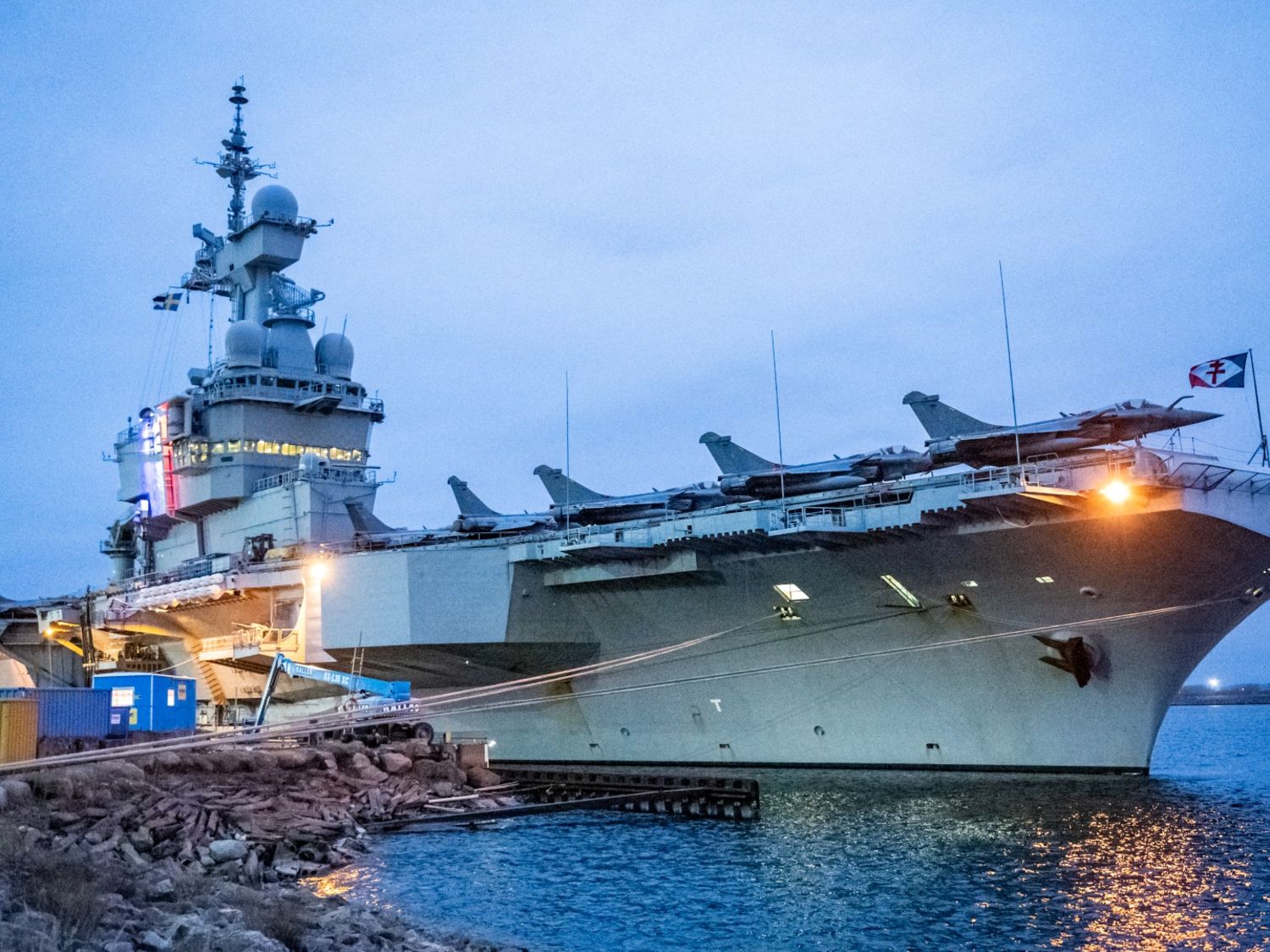
France is deploying around a dozen naval vessels, including its aircraft carrier strike group, across the Mediterranean and Red Sea, with the possibility of extending operations to the Strait of Hormuz, as part of a defensive effort to support allies facing rising threats from the conflict in the Middle East.
President Emmanuel Macron made the announcement during a visit to Cyprus, shortly before boarding the aircraft carrier Charles de Gaulle, which arrived in the eastern Mediterranean over the weekend. The French leader used the trip to reassure Cypriot authorities after drones were intercepted while heading towards the island last week, a sign of how far the conflict’s impact is spreading.
Standing alongside Cypriot President Nikos Christodoulides and Greek Prime Minister Kyriakos Mitsotakis in the coastal city of Paphos, Macron delivered a message of solidarity, declaring that any attack on Cyprus should be regarded as an attack on Europe itself.
European governments have largely found themselves on the sidelines as tensions between the United States, Israel and Iran have intensified. The conflict has already sent shockwaves through the region, striking Gulf Arab states and pulling Lebanon further into danger after Iran-backed Hezbollah launched attacks against Israel.
With vital shipping routes under pressure and oil prices climbing well above 100 dollars a barrel, European powers are now increasingly focused on protecting their economic and strategic interests. Macron stressed that France’s actions were defensive in nature, aimed at supporting countries targeted by Iran’s retaliatory moves while helping to ease tensions across the region.
He said France’s priority was to ensure maritime security and safeguard freedom of navigation through some of the world’s most important sea lanes, a goal that has become more urgent as the conflict threatens commercial shipping.
Europe’s main naval effort in the region currently centres on the European Union’s Red Sea mission known as Aspides, Greek for “Shields”. Launched in early 2024, the operation protects commercial vessels from attacks by Iran-aligned Houthi fighters in Yemen, who have targeted shipping in support of the Palestinian militant group Hamas during its war with Israel.
Mitsotakis signalled that Greece would join calls for stronger European participation in the mission, acknowledging that only a limited number of countries are currently involved. He said Europe needed to demonstrate its solidarity in more practical ways by committing additional ships to the operation.
France already contributes one warship to the Aspides mission, but Macron said that number would soon rise to two. In total, Paris plans to deploy eight warships, its aircraft carrier strike group and two helicopter carriers to the wider region.
Macron also indicated that the French presence could eventually extend to the Strait of Hormuz, a critical maritime chokepoint for global energy supplies. He said France and its partners were working on plans for a purely defensive escort mission designed to protect container ships and oil tankers once the most intense phase of the conflict subsides.
The aim, he explained, is to gradually reopen safe passage through the Strait of Hormuz and stabilise commercial traffic through one of the world’s most strategically important waterways, though he offered few details about how the proposed mission would operate.