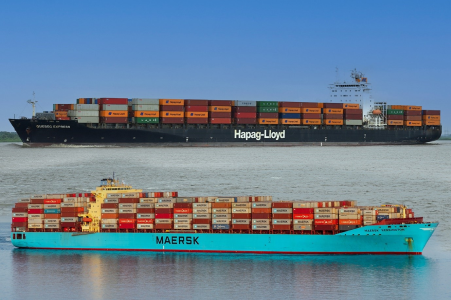
Global shipping leaders Maersk and Hapag-Lloyd have announced a carefully measured return to the Red Sea and Suez Canal corridor, signalling a tentative restoration of one of the world’s most critical maritime trade routes.
The decision affects a jointly operated service under their Gemini Cooperation, with both carriers confirming that all voyages through the region will take place under naval escort to ensure maximum security.
The service impacted by the adjustment is the IMX route, which links major commercial hubs across India and the Middle East with key Mediterranean destinations.
The revised routing is scheduled to take effect from mid-February, beginning with westbound sailings led by the vessel Albert Maersk and eastbound journeys commencing with Astrid Maersk. The move represents a cautious but notable step towards reinstating trade flows through the Red Sea after prolonged operational disruptions that forced shipping lines to seek alternative routes.
Both companies indicated that similar adjustments could be introduced for the SE1 and SE3 services at a later stage, although such decisions will depend heavily on prevailing security conditions within the region.
They reassured customers and industry stakeholders that any further changes would be communicated promptly as developments unfold. For now, the carriers confirmed that no additional modifications to the Gemini Cooperation network connected to the Red Sea are being planned.
Maersk and Hapag-Lloyd emphasised that the transition back to the route is being executed with careful attention to maintaining service stability and minimising disruptions to global supply chains.
The carriers reiterated their commitment to schedule reliability, which remains a central objective of the Gemini Cooperation’s operational strategy.
Security remains the overriding concern behind the decision, with both companies stressing that extensive protective measures will be enforced throughout the voyages. They underscored that the safety of seafarers, vessels and cargo remains their foremost priority, noting that naval support will play a crucial role in safeguarding operations along the sensitive corridor.
The companies further stated that they would continue to closely monitor developments across the Middle East, explaining that any expansion of Red Sea transits would depend on sustained regional stability and the absence of renewed escalation that could threaten maritime security.
The move is widely regarded as a significant indicator of cautious confidence within the global shipping industry, reflecting efforts to balance commercial efficiency with the complex realities of geopolitical risk in one of the world’s most strategically vital waterways.