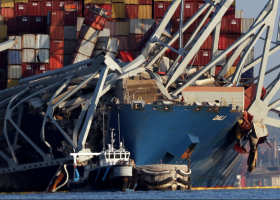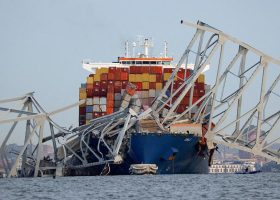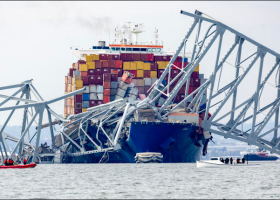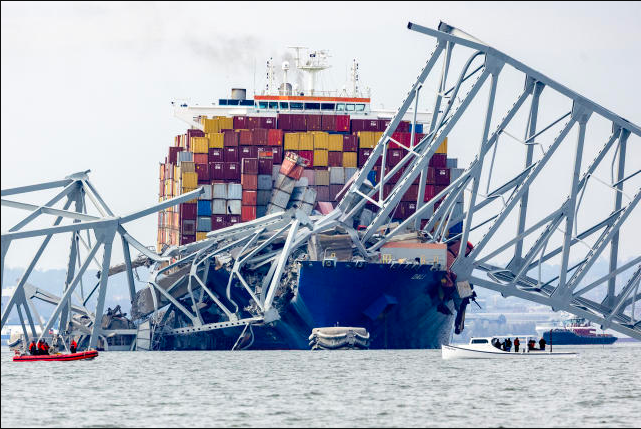
The State of Maryland has finalised a record-breaking $2.25bn settlement with the owner and operator of the containership M/V Dali, marking the largest legal recovery in maritime history following the catastrophic collapse of Baltimore’s Francis Scott Key Bridge.
The agreement resolves claims brought by Maryland against Singapore-based Grace Ocean Private Limited and Synergy Marine Pte. Ltd., the owner and operator of the vessel that struck the bridge on 26 March 2024, triggering its collapse and killing six construction workers.
Announced on Tuesday by attorneys representing the state alongside the Maryland Attorney General’s Office and several external law firms, the settlement covers damages linked to the destruction of the bridge, environmental harm, lost toll revenues, disruption to the Port of Baltimore and wider economic losses across the state.
Maryland Attorney General Anthony G. Brown previously described the agreement as a critical step towards “making Maryland whole” after the devastating disaster.
The final payout dwarfs the roughly $43.7m liability cap sought by Grace Ocean and Synergy under the Limitation of Liability Act of 1851, a centuries-old maritime law that allows shipowners to limit liability to the post-casualty value of a vessel.
The deal was struck just weeks before court proceedings were due to begin over whether the companies could rely on those protections.
While the settlement resolves Maryland’s claims against the vessel’s owner and operator, the state has reserved the right to pursue additional claims against other potentially responsible parties, including issues relating to the ship’s design and technical modifications.
The legal battle intensified further this week after federal prosecutors unveiled criminal charges against Synergy Marine, related management entities and technical superintendent Radhakrishnan Karthik Nair.
Prosecutors allege the companies knowingly operated the Dali with unsafe modifications that weakened critical electrical redundancies aboard the vessel and contributed to the blackout sequence that left the ship without propulsion or steering moments before impact.
According to the indictment, investigators claim operators relied on a flushing pump that was not designed to restart automatically after a blackout, contributing to a second power failure following the initial electrical fault.
Shipbuilder HD Hyundai Heavy Industries has separately alleged that the vessel’s operators bypassed built-in safety redundancies after delivery by replacing automatic fuel supply pumps with the non-redundant flushing pump configuration.
The National Transportation Safety Board previously identified a loose signal wire in a high-voltage switchboard as the trigger for the first blackout aboard the nearly 1,000-foot containership.
The bridge collapse shut down the Port of Baltimore for weeks, disrupted regional supply chains and forced more than 34,000 vehicles a day onto diversion routes around the harbour.
Total economic damages linked to the disaster are estimated to exceed $5 billion, while replacement costs for the Francis Scott Key Bridge are projected at between $4.3 billion and $5.2 billion, with completion not expected until around 2030.