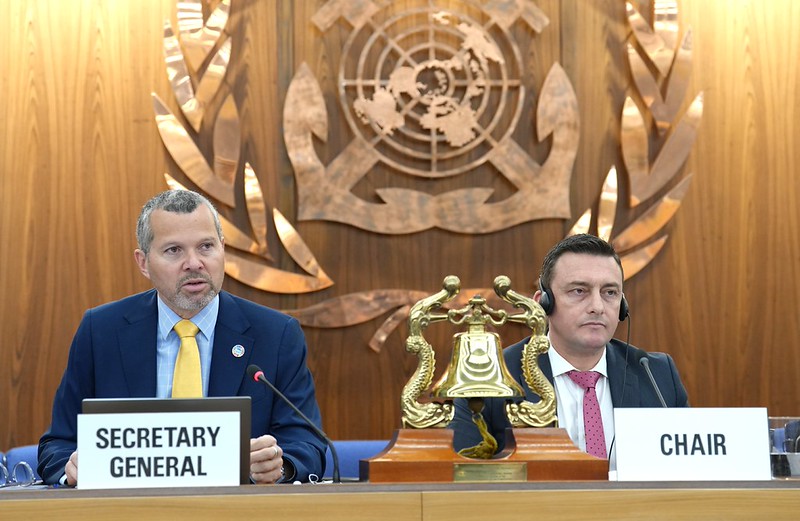
The International Maritime Organization (IMO) has adopted the world’s first international framework governing autonomous commercial vessels, marking a watershed moment for an industry racing towards remotely operated and fully self-navigating ships.
The new International Code of Safety for Maritime Autonomous Surface Ships, known as the MASS Code, was approved this week during the Maritime Safety Committee’s 111th session in London, signalling the clearest regulatory push yet towards the future of autonomous shipping.
In announcing the move, the IMO described the code as a landmark framework designed to place the organisation “at the forefront of regulating emerging technologies”, while ensuring safety, accountability and human oversight remain central to global shipping.
The adoption follows years of regulatory work by the UN shipping agency as autonomous technology rapidly reshapes the maritime sector. Trials involving remotely operated and semi-autonomous vessels are already taking place in several parts of the world, particularly on shorter coastal and port-to-port routes.
The IMO first launched a regulatory review in 2021 to examine how existing international maritime treaties would apply to ships operating with different levels of automation. The exercise covered critical areas including navigation, safety, crew training, liability, search and rescue, and port operations.
Under the new framework, the IMO has defined four levels of autonomy, ranging from conventional ships equipped with automated decision-support systems to fully autonomous vessels capable of making operational decisions without direct human involvement.
The review also exposed a series of thorny legal and operational questions still facing the industry, including who qualifies as a vessel’s “master” during autonomous operations, the responsibilities of remote operators, and liability issues linked to machine-led decision-making.
According to IMO documents, the MASS Code addresses a broad spectrum of technical and operational challenges, including cybersecurity, remote communications, navigation systems, fire protection, cargo handling, machinery operations, watchkeeping and search-and-rescue obligations.
The code will initially remain non-mandatory as regulators and industry players enter what the IMO describes as an “experience-building phase” later this year, aimed at gathering operational data and refining the framework before binding regulations are introduced.
Under the organisation’s revised roadmap, work on a mandatory MASS Code is expected to begin in 2028, with formal adoption targeted for 2030 and entry into force planned for January 2032.
The Maritime Safety Committee meeting also focused on mounting security concerns around the Strait of Hormuz, maritime digitalisation, greenhouse gas safety measures tied to alternative fuels, and updated regulations for hydrogen and ammonia-powered vessels.