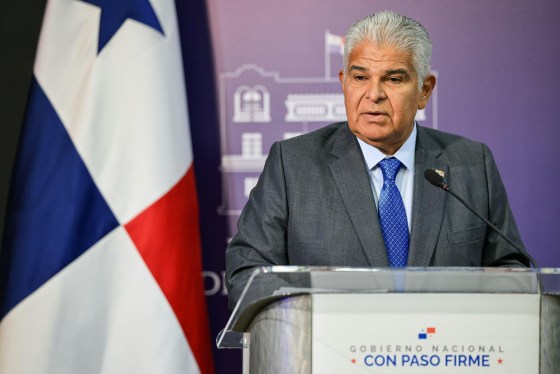
Panama’s president, José Raúl Mulino, has declared an abrupt end to his country’s confrontation with the United States, framing it as a restored friendship that leaves the Panama Canal firmly in Panamanian hands.
Speaking last Friday in his New Year address to the National Assembly, Mulino said tensions with Washington had been defused after Donald Trump threatened to reclaim the canal in early 2025, claiming it had fallen under Chinese influence.
According to Mulino, Panama chose cooperation over confrontation, rebuilding trust through quiet resolve and patient diplomacy while safeguarding its sovereignty over the waterway.
Trump’s pressure campaign began almost immediately after he took office on 20 January last year. He demanded that Panama dismantle the operations of Panama Ports Company, the local arm of Hong Kong-based Hutchison Ports that runs terminals at both ends of the canal, and insisted that US vessels be granted free passage.
Faced with the prospect of an escalating standoff with an unpredictable administration, Mulino moved quickly to calm relations, presenting Panama as a reliable partner rather than a defiant target. He said the two countries were now working closely together, particularly in tackling international crime, signalling a willingness to align with Washington’s priorities.
The timing of Mulino’s announcement raised eyebrows across the region. It came shortly before US forces captured Venezuelan president Nicolás Maduro in a military operation, an extraordinary move the United States justified by charges of narco-terrorism, cocaine trafficking and weapons offences.
The images from Caracas inevitably revived memories in Panama of December 1989, when US troops ousted Manuel Noriega in an operation launched exactly 36 years earlier.
For many observers, Mulino’s haste in patching things up with Trump looked less like coincidence and more like calculation, a determination to ensure Panama never became the next cautionary tale.
Mulino’s reaction to events in Venezuela underscored this delicate balancing act. Writing on X on 3 January, he expressed support for democratic processes and for what he described as the clear electoral mandate of opposition leader Edmundo González.
He called for an orderly and legitimate transition, positioning Panama firmly on the side of democracy and peace, while carefully avoiding any rhetoric that might antagonise Washington at a moment when US power had just been dramatically asserted in the region.
Behind the diplomatic choreography lies the unresolved question of Chinese-linked port operations at the canal. In March last year, CK Hutchison reached a preliminary deal to sell most of its global port portfolio, including its Panamanian terminals, to a consortium led by BlackRock and Terminal Investment Limited, the port arm of shipping giant Mediterranean Shipping Company.
Yet by late December the talks had stalled, with Beijing reportedly objecting unless China’s COSCO Shipping Group was given a significant stake. At the same time, Hutchison Panama’s concession is under legal attack at home, with a constitutional challenge now awaiting a ruling from Panama’s Supreme Court, expected later this month.
These disputes unfold as Panama reflects on more than a quarter of a century of full control over its most prized asset. On 31 December 2025, the Panama Canal Authority marked 26 years since the canal was transferred from US to Panamanian hands in 1999. In that time, the authority has channelled around $31.2 billion into the national treasury, cementing the canal’s role as the backbone of the economy and a vital artery of global trade.
Looking ahead, the authority has set out an ambitious investment programme aimed at keeping the canal competitive, with projects spanning ports, energy logistics and water management to support both shipping and domestic needs.
For Mulino, the message is clear. In a hemisphere where defiance can invite drastic consequences, Panama has chosen pragmatism. By swiftly making peace with Trump, the president has signalled that his country intends to protect its canal, its economy and its stability by staying close to Washington’s good graces, having watched how swiftly a less accommodating neighbour was brought to heel.