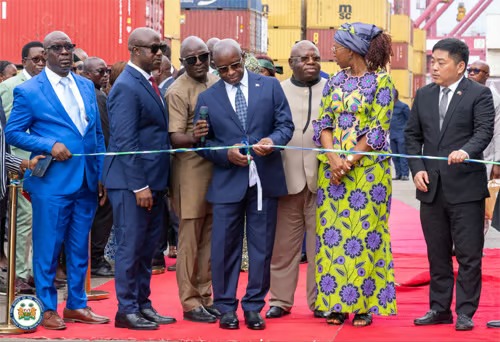
Sierra Leone has launched a new national shipping venture as governments across Africa step up efforts to build domestic fleets, strengthen maritime capacity and reduce reliance on foreign carriers.
President Julius Maada Bio presided over the launch of the Sierra Leone Ocean Shipping Company (SLOSCo) recently at the Queen Elizabeth II Quay in Freetown, the country’s capital and principal port city. The initiative forms part of broader government reforms aimed at revitalising the maritime sector and giving Sierra Leone a greater role in international shipping.
The ceremony took place against the backdrop of the Chinese-owned bulk carrier XH Explorer, a 176,298-dwt vessel built in 2003 and registered in Liberia. Managed from Singapore, the ship has been operating between Sierra Leone and Asia, highlighting the international shipping links the new venture hopes to build upon.
The launch follows a series of legislative changes designed to modernise the country’s maritime industry. Recent measures include the Revised Merchant Shipping Act 2026, the Maritime Pollution Bill and the Sierra Leone National Shipping Agency (SLNSA) Act 2025. The latter transformed the former Sierra Leone National Shipping Company (SLNSC) into the new agency, giving it a revised mandate.
Established in 1972, SLNSC played a role in facilitating exports of timber, minerals and agricultural produce. However, Transport Minister Alhaji Fanday Turay said the organisation needed a new vision to deliver “greater efficiency, flexibility, and authority”, arguing that a more dynamic structure was necessary to meet the country’s evolving maritime needs.
Under the new framework, Sierra Leone is partnering with China’s Zhejiang Xiehai Group to establish SLOSCo. Parliament approved the joint venture agreement in August, with Zhejiang Xiehai holding a 70 per cent stake and SLNSA retaining the remaining 30 per cent.
The company plans to build a fleet of 50 vessels, with the first phase targeting the acquisition of 30 ships. If realised, the programme would mark a significant expansion of Sierra Leone’s participation in international cargo transport, although the timeline for fleet development has yet to be detailed.
“For far too long, we have relied on international carriers to export and import our products. We are now taking a bold step forward, giving Sierra Leone a greater stake in transporting the goods we trade with the world,” President Maada Bio said.
Following SLOSCo’s launch, representatives of Zhejiang Xiehai met with the leadership of the Sierra Leone Ports and Harbours Authority (SLPHA) to discuss ways to improve cargo movement and port efficiency. Potential investment in cargo-haulage trucks was among the issues considered, with the aim of easing congestion at the Port of Freetown.
SLOSCo is also expected to build on an existing direct shipping connection between Taizhou Port in China and the Queen Elizabeth II Quay in Freetown. The route was launched in December 2025 and could provide a foundation for expanding trade links between the two countries.
Sierra Leone’s initiative comes as regional efforts gather pace to strengthen African shipping capacity. The Maritime Organization for Eastern, Southern and Northern Africa (MOESNA) has approved in principle proposals to establish a Regional Shipping Lines Network and a Regional Maritime Cabotage Protocol.
The decisions were taken last week at the organisation’s 10th Assembly of Ministers responsible for Shipping and Maritime Affairs and Trade and Commerce, as member states explored ways to develop indigenous shipping services through greater regional coordination.
Despite its extensive coastline, major seaports and considerable trade potential, the Eastern, Southern and Northern Africa (ESNA) region continues to suffer from limited direct shipping connections between member states. Many countries remain dependent on transshipment services routed through ports outside the region, adding to freight and logistics costs.
The proposed Regional Shipping Lines Network is intended to address these gaps by providing a coordinated framework for developing services tailored to regional cargo volumes, trade patterns and existing connectivity needs. The proposed cabotage protocol could further support efforts to strengthen regional maritime links, although its eventual scope and implementation arrangements remain to be established.
Together, Sierra Leone’s new shipping venture and MOESNA’s regional initiative reflect a growing push to give African countries a greater stake in moving their own goods. The challenge now will be to turn ambitious fleet plans and regional policy commitments into commercially viable services capable of reducing costs, improving connectivity and capturing a larger share of the continent’s maritime trade.