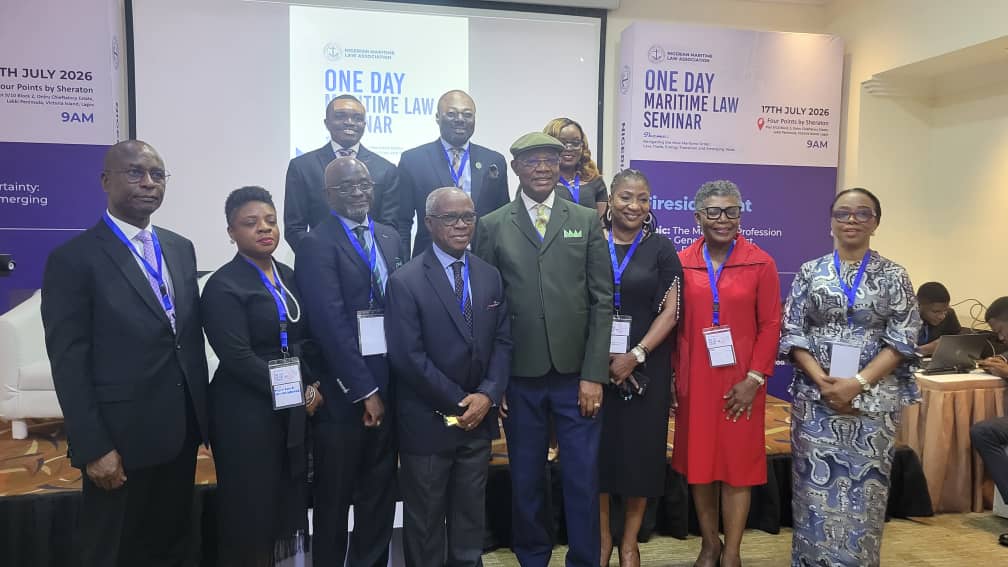
A senior Advocate of Nigeria, Professor Adewale Olawoyin, has warned that Nigeria’s maritime legal framework is struggling to keep pace with cyber threats, satellite-navigation interference, autonomous vessels, electronic trade and the growing “dark fleet”, calling for urgent legislative reforms to protect the country’s maritime economy.
Olawoyin spoke at the 14th annual one-day seminar of the Nigerian Maritime Law Association (NMLA) in Victoria Island, Lagos, where he said the rapid transformation of global shipping was exposing serious gaps in Nigeria’s laws.
Speaking on the theme, “Navigating the New Maritime Order: Law, Trade, Energy Transition and Emerging Risks”, he said the country’s maritime statutes had developed piecemeal over decades and were increasingly ill-equipped to deal with the risks created by a digitised and rapidly changing industry.
He said Nigeria needed a Blue Economy Coordination Act to harmonise the sector’s fragmented laws and give the Federal Ministry of Marine and Blue Economy the statutory authority to coordinate agencies whose mandates often overlap.
He also called for a standalone National Single Window Act and an independent body to oversee the trade-facilitation platform, arguing that the system should be driven by speed, predictability and neutrality rather than being anchored solely within a revenue-focused agency.
The maritime lawyer warned that cyber incidents, falsified satellite-navigation signals, autonomous vessels, electronic bills of lading and the expansion of sanctioned “dark fleets” were creating legal risks that existing laws on carriage, marine insurance and admiralty procedure were never designed to address.
He urged the NMLA to establish permanent working groups to develop legislative and policy proposals on blue economy coordination, trade digitisation, decarbonisation, cabotage, maritime security and emerging risks.
NMLA President, Mr. Mike Igbokwe, SAN, said the association would continue to promote legal education, reform and thought leadership as technology, environmental obligations and changing commercial practices reshape the maritime industry.
He said the maritime lawyer of the future must be a problem-solver, risk adviser and innovation partner as Nigeria seeks to build a competitive marine and blue economy.